Showing posts with label Bagan. Show all posts

Thursday, May 16, 2013

Myanmar Part 8 (b) - Last Day in Bagan

Waking early, our day began similarly to the previous one; eating an ample and leisurely breakfast. J wanted some cigarettes and I wanted to buy some extra water so we headed out to find our supplies. Not far along the road, there was a local shop selling all sorts of wares including washing powder, children’s toys, local snacks, drinks, smokes and fruit. Crammed full to the brim, it even had a few postcards and touristy souvenirs. Serving us, the owner asked us what we were doing that day in textbook perfect English. We responded that we hadn’t decided. Soon, we chatted to him about the temples we’d seen yesterday with our horse-cart driver the previous day. He then told us that he had a brand new car and he could drive us around anywhere for the day for 30,000 kyats. Sure! Why not.
He asked us to come back in 30 minutes as he had to call his brother to bring the car from their village. Back at the hotel, we asked the staff about the weather, as cyclone Mahasen was menacing off the coast and due to make landfall. Already, the sky was heavy with cloud and it was a little windy. However, they also said that it didn’t look like it would come too close to Bagan. Despite that, many locals were taking shelter.
Right on time, we arrived back at the shop as a new silver Toyota sedan was pulling up. Naing Naing, our driver and shop keeper, leapt out to open the rear doors for us to get in. That new car smell hit us. It was abundantly obvious that Naing Naing was proud of his car, and maybe just a tad overprotective. The seats were covered in a hard plastic sleeve, like those horrible sofa settings from the 1960s. Driving along, he barely hit 40km/h on the asphalt road, and on the dirt tracks, he crawled at what seemed to be almost slower than walking pace.
Since we had told him we had seen old Bagan and the area not far from it to the south-east, he suggested going towards the north to Nyaung-U, starting at Shwezigon Pagoda. It’s a huge gold zedi and one of very few made almost wholly of stone. There’s a legend that the people who built it stood in a seven mile long row stretching to the nearby quarry to relay the stone bricks to the site. Many pavilions contain various precious objects and shrines which we explored slowly. On the eastern side of the great stupda, there’s a 15cm indent full of water. It was made to allow royalty to view the hti on the top of the gold structure in the reflection of the puddle, so they didn’t have to tip their heads back to look so far up at it, risking their crowns to topple off their heads.
Though we had seen a few other travellers in Old Bagan, this was the first place where we saw many other tourists. Like me, people were wondering around with their SLRs firing away taking photos. On the corners of the great pagoda, stylised lions sit appearing as a single lion when view side on, but from the front appeared to wrap around the corner, conjoined at the head with separate bodies on each side. Ornate golden offerings lined the walkways. Many pavilions held stone Buddhas and golden reclining Buddhas. It was a large complex, busy with locals and travellers alike.
Off to one side was a cave-like temple that I had to squat-crawl to get inside. A gold Buddha covered in gold leaf sat at the alter with carvings on the surrounding walls. This was a place of perhaps the only unhappy incident I had in Myanmar. Inside this little temple were three older women, who I took to be pilgrims paying their respects. The encouraged me to come right in up to the alter. Next, they pretty much forced gold leaf into my hands to place on the Buddha. “Good luck! Good Luck! Happy Buddha! Happy Buddha!” Guiding my hand, they helped me put the gold leaf on the Buddha’s head, hands and feet. At first, I thought they were acting on good intentions. Then, they turned around and asked for 1000 kyats per sheet. They blocked my exit form the little temple, where J was waiting outside unaware of what was happening. As I tried to leave, they held my arms and insisted I pay them, getting aggressive and shouting, “You pay! 5 Gold! You Put! Now pay!” Wanting to avoid a scene, I opened my wallet where I only had 3, 1000 kyat notes and handed them over, explaining I had no more. Though clearly unhappy, they then let me pass.
Rattled, I found J, who had wondered off. He was shocked to hear what happened. Then the women returned inside waiting for another victim. Determined not to let this discourage me, we walked off to explore the temple further. However, we were met by our driver who was in a bit of a panic. “Sorry, but your hotel has a fire. We need to go back”. A what?!?! Fire? Holy moly. We had left my mobile phone recharging in the room when we left. Don’t tell me it had shorted and started the fire. The plug had looked a bit loose…
Hurrying back to car, we headed back where we found the area swarming with motorbikes and cars with most of the town’s people watching on. Smoke rose above the buildings with an acrid smell filling the air. Hotel staff met us as we pulled up and ushered us inside. “Fire is out. No worry. Everything is OK”, she explained, struggling to hold back tears. Walking past the swimming pool where staff were mopping up, we returned to our room that was completely unaffected. The fire had occurred in some rooms that were in a different wing of the hotel that were undergoing renovations. Apparently, a drill or electric saw had set off the fire. People had come from everywhere to put it out using the pool water to fill buckets and hoses to dowse the flames. From what we saw, it must have been intense, with the roof completely burnt, windows blown out and smoke damage visible on all the walls inside and out.
At reception, we asked if we could help, but we were told that it was all OK and to enjoy our day while they cleaned up. “By tonight, it will all be fixed”, she said. Surprisingly, when we returned later that evening, new glass had been fitted to the windows, and the roof was already being repaired. No-one had been injured. I was glad that though it was a potential disaster, the care and skills of the staff had made sure no-one was affected.
Resuming our day’s sightseeing, next was the impressive temple Htilo Minlo, which is on the road between Nyaung U and Old Bagan. Before we got out of the car, Naing Naing gave us a brief run down of the temple’s history. Apparently the temple’s name comes from a legend when the local king of the time was trying to decide which of his sons would succeed him. So he had his sons stand in a circle and stood a white umbrella on it’s end in the centre. He then let the umbrella fall. The son standing in the direction that the umbrella fell become the next king. This temple sits on the spot where the umbrella fell, and the name means, “the king favoured by the white umbrella”.

The exterior walls had intricate detailed scrollwork and carvings. Inside were huge, detailed, ink frescos, which are reportedly horoscopes of various events in the temple’s history. Huge vaulted galleries housed Buddhas facing the four cardinal directions. We spent a good half an hour exploring the painted corridors and terraces. The weather was starting to close in and the wind had picked up. However, it was still a blistering 40 degrees so the stiff breeze was very welcome.
With the clouds now building, we asked Naing Naing whether he had any updates on the cyclone. He said it was far away, but it would probably rain soon. Confirming what we had heard earlier, many locals had stayed home and took cover, just in case.

Having asked to visit some temples a little off the beaten track (well as much off the track as could be in the tourist packed Bagan), we took a side road off the little town of Wetkyi In to Gubyauk Gyi temple. Gubyauk means painted temple. From the outside, it appeared to be a simple, non-descript temple. Inside were beautiful paintings depicting the lives of the Buddha before he reached Enlightenment. Many looked as if they were painted yesterday. Lots of colours and designs filled the walls. The only problem was that no photos were allowed (even with no flash). The local gatekeeper, who had come around when he saw us arrive, kept an eye on me to make sure.
Not to worry, the set of next temples were close by. In fact, this next area was one of my favourites. Being alone (apart from our car and a few locals) in that ancient landscape littered with thousands of red bricks from temples and walls long fallen was simply inspiring. Spires of near-by temples rose above the sparse trees and dust adding scale to the view. We poked around a few of the ruins and temples, many without name, just numbers.

We parked under a scrawny tree where a local vendor tried to sell us postcards and wood carvings. Not interested, we said our ‘No thank yous’ and headed to the temple before us. Unusual for its inter-connected temples, Paya Thonzu temple’s name means three temples. The small square buildings were connected by a narrow, arched passageway. Naing Naing told us that the triple-temple was not finished, as end temples’ paintings were never completed, while the others were covered in gorgeous images of flowers, animals and birds.
Many pictures of Buddhas are also depicted as well as scenes from the life of Gotama Buddha, the historical Buddha. Interestingly, there are also images of Bodhisattvas (beings that dedicate their lives, and all future lives, to benefit all sentient beings until they achieve enlightenment before the Bodhisattva seeks their own liberation) attributed to Mahayana Buddhism, and not usually seen in Theravada Buddhism which prevails in Myanmar. Apparently, a separate sect of monks and priests lived in the area, explaining the curious pictures. Unfortunately, we could not take any pictures inside the small temple.

Walking up a little hill, we entered an impressive temple that looked similar to the Sulamuni temple. Thambula temple is named after it’s builder, Queen Thambula. However, an old stone engraving shows its name to be Thonlula, which is taken from the Pali language meaning “Moon of the three worlds”. Encircled by wides porches, it was set on a rise overlooking the plain dotted with many temples and various states of disrepair.
Inside the huge archway, two local artists were working away on bamboo scaffolds, performing restoration works on the temple’s many murals. They welcomed us inside and motioned for us to look around. With the extensive scaffolds, there wasn’t much room to move, with most of the statues and paintings obscured. But many original pictures were still visible and had beautiful detail of the Buddha and scenes from his life.
On the way to New Bagan, we stopped at Dhamma Yarzika pagoda that was in the process of being re-guilded. It’s a bell-shaped stupa said to be built on the site where the King of the time saw a line of smoke rising from the ground. Seeing it a good omen, he built this temple and enshrined relics of the Buddha. Different to other pagodas, it has a pentagonal base, instead of the usual square. On each side there were small temples covered in murals, four contained a statue of one of the past Buddhas and the last one had a statue of the future Buddha. J and I walked around its large terrace, but by this stage, the weather had broken and rain was falling steadily with the wind was blowing a gale. So our circumambulation was a bit rushed under umbrellas being blown inside-out, missing the opportunity to explore and absorb as much as we would have otherwise.

Arriving in New Bagan well past 2pm, the town seemed deserted under grey and gloomy skies. Our driver chose ‘The Green Elephant’ for lunch, where we were the only patrons. Thai curries and fragrant rice provided a satisfying lunch, though a little over seasoned and under spicy, clearly tamed down for tourists. But the beer was cool and refreshing. Even though the weather had turned, the temperature was still in the mid 30s with 100% humidity!
To finish our day, Naing Naing chose Manuha temple, where 3 enormous seated Buddha statues are housed. The tiled terrace leading to the temple was very slippery, now bathed in a few millimetres of rain. Three maroon clad monks were making their prostrations as we entered. Seeing us, they turned around, one said something to the others to which they giggled, and we were quickly the subject of their photos, taken on their smart phones. It was only fair as I took their photos too.
J and I explored the 3 chambers, marvelling at the huge Buddhas. Each was different, with slightly different facial expressions. The central Buddha is the largest sitting 46 feet tall, with the two Buddhas flanking him a mere 33 feet. Apart from the huge statues, the temple was fairly plain, with a smell of fresh plaster in places, and mould in others. As we were leaving, a young family arrived. Excited, the two young boys ran to one end, immediately clambering over the Buddha’s lap. Trying not to yell too loud, the mum told them to get off, scolding them, before settling down to her prayers. Some conversations need no translation.

Back in Old Bagan, we bid a very fond farewell to Naing Naing, agreeing to have him drive us to the airport the next morning, before we slid out of those plastic-coated seats. The rain was clearing, though the clouds still stood heavy in the sky. It was great to rinse the sweat and dust of our faces in the cool air-conditioning of our room. However, I had itchy feet, wanting to stretch after being in the back of a car for a large part of the day.

Nagging poor J to get up with the argument that we hadn’t even seen the Irrawaddy river, we headed out for a quick wonder around Old Bagan. At least the sting had been taken out of the sun with the cloud cover, and the air felt a little fresher after the rain. Through the Tharabar gate, we walked the little way down to the jetty, beside the Aye Yar River Hotel (which looked very nice). A crew of horse carts was waiting for tourists and did their best to get J and I in one for some sight seeing. But I was keen to walk.

Local kids were mucking around the dried up river shore. It was dry season, so the mighty river was subdued with much of the bank exposed. White cattle were grazing on the sparse grass growing in tuffs where the river would have flowed. Boats were on blocks undergoing repairs or repainting, ready for the wet season due any time now. A local man approached, wanting to take us for a trip in his little boat. Smiling, we politely refused, choosing instead to walk around the riverside. Looking across the wide waterway to the distant mountains, the banks of clouds seem to be unwinding exposing stretches of blue sky towards the western horizon.
A crumbly road lead off further westward to Bu Paya, a barrel shaped stupa set on the banks of the Irrawaddy. It is said to be the earliest Buddhist zedi built in Bagan, when the area was first  settled by the Pyu community. The golden figure standing there now is a replica, as the original fell into the river during the great earthquake of 1975. Though not as remarkable as many of Bagan’s temples, with no murals or gold Buddhas, it was a lovely place. With the sun sinking behind the remnants of the distant storm, and the light turning a golden hue, J and I relaxed, enjoying the view and late afternoon atmosphere.
Nearby, the small town had a few stalls and restaurants. Must be time for a refreshing beer. We sat at a small table on the rear deck of one of the cafes with a cold one in the afternoon sunshine. Outside, the village had sprung into life with many motorbikes buzzing here and there. It was hard to believe this sunny afternoon was the same day as the one earlier. 

Further along the road, we stopped in to check out Atwin Zigon pagoda and Myet Taw Pyay  pagodas that sat side-by-side. Overgrown with weeds in places, and falling down in others, they were interesting structures to explore. The late sun had brought a return to the stinging heat, so the shady grounds of the deserted pagodas were cool and relaxing.

On the way back to the hotel, our last stop was to the graceful Gawdaw Palin temple. It is said it was built as a penance for a sin committed by the king that built it. Most of the walls had been whitewashed, which was a great shame as the few remaining murals were stunning. Gold Buddhas faced the four directions and many corridors ringed the main hall. Many hidden corridors were found after the earthquake, but they were gated off, out of bounds, as were the staircases leading to the upper levels. Pity, it would have been a wonderful view from up there, with the river close by.

Quickly refreshing ourselves, we hurried to the Ananda temple to meet Aye Aye, the lady we had met yesterday, who offered to have dinner with her. Arriving bang on time, the stalls were shut up, and the area deserted. We wondered up the path near by, looking for her. The whole temple area was very quite with very few locals anywhere. I guess people had stayed away from the storm warning earlier in the day. Not to worry, J and I headed back towards the hotel for a meal at the Sarabha II restaurant, with beer and pizza (I know – something too touristy), after a beautiful day. I wished we had more time in Bagan, as tomorrow we were on an early flight to Mandalay. Bagan is a true treasure, and I have to return one day soon.


- K

Wednesday, May 15, 2013

Myanmar Part 8 - Bagan Day 2

Originally, the plan was to get up early, find a good vantage point, and take some dawn photos. However, a few factors meant that was not the best idea. First, we learned that bad weather was on its way. Staff had told us the night before that cyclone Mahasen was due to make landfall to the south-west in Rakhine state, blowing in from the bay of Bengal. It was feared that its effects would be felt in Bagan and locals were battening down the hatches. Second, the sky was heavy with clouds with wind rattling the windowpanes. Lastly, we were exhausted and found ourselves unable to get up and going at the required hour.
Instead, we had relaxing morning (though still up comparably early), enjoying the excellent breakfast spread at the hotel at Tharabar gate. As we were heading out of the room, I remembered the travel tube of Vegemite we had purchased while waiting for our flight in Sydney. I love my Vegemite on toast, and ot a fan of all the sweet spreads usually on offer. J loaded up his place with the various eggs and meat dishes while I made my toast. Once I had spread on the thick black splodge, I noticed the staff curiously watching me. “Have you seen this before?” I enquired. Shacking heads in response. Best they have a taste! Cutting the slice into a few pieces, I handed them to the wait staff, and told them to take a piece to the cook and other staff too. I tried to tell them that it was an Australian delicacy, or local Aussie food. Judging by how salty many of the Myanmar dishes were, I guessed the locals would enjoy it. Sure enough, they did. Much chatter and laughing, with wide smiles followed. Filling a condiment bowl, I left some for others who wanted to brave a taste. It went down a treat!
Ready to explore, we set off to find our persistent horse cart driver from the day before. As he promised, he was directly out the front of the hotel. Seeing us coming, he moved his rig to meet us at the end of the driveway. We negotiated a rate for half the day, and left it up to him to pick the route and temples. There was only one particular place I wanted to go at some point, a highly recommended lacquerwear store in Myinkapar village. But first some temples.

J rode up front with the driver, while I lounged in the back on the mattress-like rear seat. Swaying and rocking along with the motion of the horse, I relaxed and sat back, watching the scenery go by. The steady clop-clop-clop of the hooves was so soothing in the heat, while the leisurely pace allowed us to see the many hundreds of temples, big, small and every size in between, set in the fields all around.

Passing some large, impressive temples, we arrived at Pya Tha Dar (or Pya That Gyi) Temple. Our driver didn’t speak a lot of English, but told us it was not finished back in the 1200’s because the King’s son ran out of money. Impressive as the massive vaulted corridors are, the main attraction was the roof, or rather the view from the roof. A very narrow set of stairs led up steeply. Even the staircase’s roof was vaulted.

The view from the top offered sweeping view of the Bagan plain. Best of all, we were the only ones there. We explored and studied the view, before looking through the lower levels and the huge corridors with the plastered, white-faced Buddhas with brown robes. I later read that the main barrel vault over the main shrine is the largest in Bagan measuring 25 feet wide and 50 feet long. Before we left, we made notes to return for sunset.

Next stop was just down the road – Sulamuni temple, a truly awe-inspiring temple. The name, ‘Culamcini’ in Pali, means Crowning Jewel. Legend has it that the king who built it saw a shining ruby on the ground, where he took it as a sign and resolved to build the temple. An inscription on the wall of the north porch told his story.
In front of the temple was a sort of gated wall that provided a courtyard before the entrance. Along each side, a row of stalls enticed tourists to buy paintings and wood carvings, as well as cool drinks. Only a few other people wandered around, mainly locals. Removing our shoes, we entered into the courtyard towards to path into the temple. Immediately, we were approached by four or five sellers trying to sell us their wares.
Inside we meandered through the painted corridors. Apparently, most were new works, from the late 1800’s, and very little remains of the originals. Stairs led up to mostly blocked upper terraces, which we explored. They provided great vantage spots to view the paintings and vaulted ceilings. As with many temples, the central square houses four Buddha statues facing each direction. Each corner of the building also had small shrines, mostly new or modern.
Some local painters had set up shop inside the temple’s many airy corridors. J stopped to look at some of their work, and I knew he’d was done – as soon as you look, you pretty much are expected to purchase something. So, I left him to it, knowing that my presence would set another seller onto me - divide and conquer, so to speak. I used the time to reflect and say my own little prayers and prostrations before the main Buddha.
When J joined me at the entrance, he had two paintings. “How much did you get them for?” Apparently too much; 20,000 each, with no discount. Admittedly, they were gorgeous, bigger and different to the ones I bought the previous day. “Next time, best you leave the purchasing and haggling to me”, I laughed.
Nearby, we next visited Dhamma Yan Gyi Pahto. Its known for is massive size and resemblance to an Egyptian pyramid. Certainly, it was huge! Similar to the graceful Ananda temple, it had circumambulatory corridors encircling its central shrine. But the some of the other corridors were blocked, apparently due to an architectural error. They say that behind them are other massive Buddha statues, which they hope to excavate one day.

The name of the temple is a combination of two Pali words; Dhamma (Which most Buddhists know) means the teachings of the Buddha, and Yanthi that means light, together meaning the ‘Light of Buddha’s Teaching”.
Again, we explored the passages and their frescos and plaster mouldings. One of the halls to the side housed twin Buddhas, sitting side by side. They fascinated me, and I have yet to find the reason they were cast they way they were. Other temples have multiple, identical Buddhas, but usually many, like a hundred, not just two. Another beautiful temple.


And now, time for something completely different. Time for some shopping. Having read so much about the beautiful lacquerwear in Bagan, and being warned of inferior quality (as well as previously purchased excellent works in Vietnam therefore  understanding the difference in quality and price), we headed to the Jasmine family workshop in Myinkaba village. Our poor driver had a little trouble finding it, but after asking for directions from a local workman, quickly delivered us to the address.
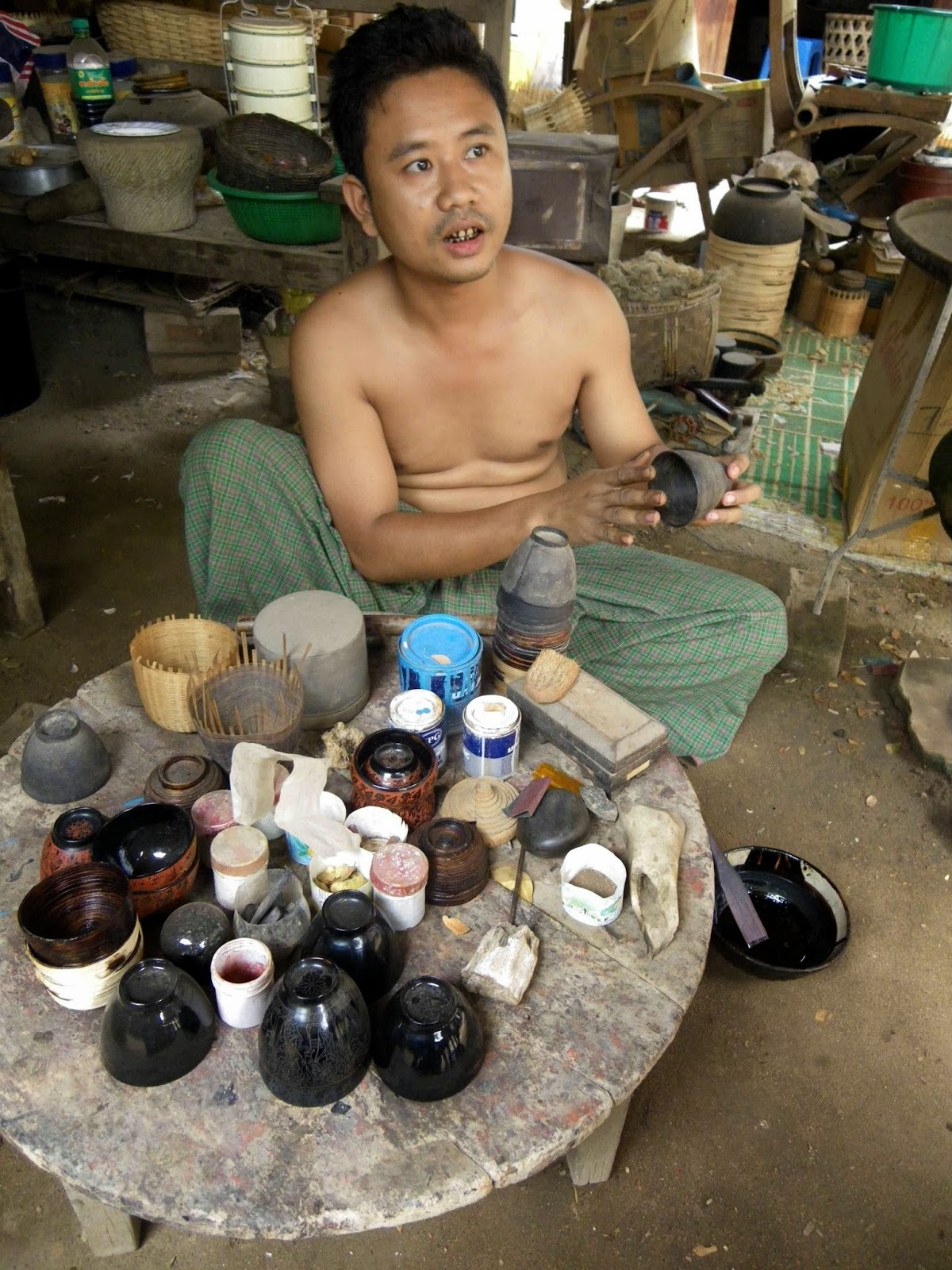
Welcomed by the oldest son, we were shown in to the simple compound with various buildings and shady verandas. He showed us the various steps involved in making each piece. Starting with woven bamboo, layers of lacquer are applied, with various carving, painting, curing and stripping steps in between. Most took over six weeks to complete. We met some of the girls tasked to carve the delicate inscriptions and patterns into the pieces, and were shown the underground curing holds. It’s a fascinating process, and very different to the process we had been shown in a workshop we had visited in Vietnam.
Lastly, we were shown the into the simple shop at the rear of the workshop. Rows of shelves with stunning pieces, large, small, and every size in between lined every available wall space. Cups, plates, boxes, platters, vessles, trays, containers, bangles; so many choices, so many options. Some were detailed, others simple, each with different colour combinations and designs, with pricetags set accordingly. The mother of the family came in with some freshly sliced mango and cold drinks to enjoy as I selected my purchases. Asking for J’s advice, I selected pieces, then changed my mind, the tried to second guess my friends and family’s preferences – which to every comment,  J said, “Yeap”. I ended up in there for maybe half an hour before choosing over a dozen pieces.
Each piece was carefully wrapped in swathes of newspaper. I left with a huge bag full, and my purse a few hundred-thousand kyats lighter. Our driver was dozing in the shade, and upon seeing my big bag had a giggle. We’d been gone nearly an hour! “Good shopping”, he asked. I told him it was the best in all Bagan, making a double-thumbs up gesture. “OK”, he smiled. “I remember for next people who come.”
Returning to Old Bagan for lunch, we left our driver after making plans to meet him later for sunset. Refreshing with a change of tee-shirt, face wash and foot bath, we headed out to ‘The Moon - be kind to animals’ vegetarian restaurant. Hurrah, Somewhere I could order almost anything on the menu. Over some cool juices, we enjoyed spicy, stuffed rotis, followed by the most mind-blowing tamarind wafers, which were like the Myanmar version of an after dinner mint. The waitress brought over a little plate piled with these little delights. A little envelop held thin, coin-sized, slices made from tamarind pulp, covered in fine sugar. Sweet and slightly sour, we scoffed many before finally extracting ourselves before we made ourselves sick.
Over the dirt track from The Moon was an artists’ studio. The walls were covered in paintings, many sort-of the same as what we’d already seen, but many different ones. The resident artist met us, and explained the various styles, techniques, and gave us some background to the some of local artists. Well, I couldn’t help myself, and purchased a few more paintings (mostly gifts – again), for much less then the previous purchases, and certainly a lot less than poor J’s bargaining efforts.
“Let’s check out what’s up this way”, I motioned to J, leading the way up a side ‘street’ towards some deserted temples. A newish sign post stated, ‘Hsu Taung Pyi’ and ‘Min O Chan Tha” pagodas. Min O Chan Tha pagoda was a serious of white-washed stupas, with a wooden shrine at the top of a few steps guarded by clinthes. A weather-worn stone inscription read that the King (Kyansittha) built this as a tribute to house relics of the Buddha sent to Bagan by a Ceylonese king in 1112 AD. As read from the inscription, the king said, “I am quite old enough, with the meritorious deed may I be free from diseases, may I live a longer life. May the Sasana (Buddhist movement) be flourished Thus this stupa was named as Min-O-Chantha”. They say that he unfortunately died the following year.
From the rear of the platform, a nice vantage point provided a lovely view over many red-bricked temples on the plain, as well as over to Ananda temple. I moseyed around the few little temples, many with various new and no so new Buddhas, peaking in through some locked gates to a quaint shrine room lined with golden Buddhas.

Heading back, we came across a temple compound with a square-ish building in front of a faded-white large stupa. The walls had gorgeous plaster carvings, and as we wandered around, an old monk approached us. “Look in? Look in?”, he asked. At first we didn’t know what he meant. He then called out to some locals near by, and a teenage girl came running with some keys. Much to our surprise, he then showed us into the inner chamber, unlocked the large iron gate, and showed us inside the newly decorated shrine. A narrow passage, completely covered in gold, silver and multi-coloured mosaic tiles lead to a brilliant gold Buddha. Around it, strings of fairy lights hung ready to light up the hall when worshippers came to pay homage.
At this point, I rued the fact I only had my little, compact, ‘toy’ camera, not my trusty DSLR, but I couldn’t leave without taking a photo of the old monk and girl (who was deeply embarrassed though happy to smile for the camera). Both J and I emptied the few kyat notes we had left as a donation, feeling very privileged to have been shown through this little visited place.
Distracted by its elegance, we found ourselves drawn into Ananda temple from the north entrance. The town seemed deserted, and we were almost the only ones in there. Once again, we were astonished by the massive standing Buddhas and the hundreds of tiles and little Buddhas enshrined in the walls. While we were admiring the massive teak doors set into the outer corridor walls, a lovely lady approached us. Like our previous guide, she was polite, explaining that she was studying to become a tour guide and wished to practise her English. Once again, we were happy to oblige, letting ourselves be lead around and walked through the various facts and history of this beautiful temple. She also told us some facts omitted by our previous guide, such as the newly discovered vaults below the floor of western shrine, where they believe held a library and other royal treasures hundred of years ago, as well as some more facts about the frescos and their restoration. Soon we found ourselves chatting like long lost friends about family and relationships.
For once, I remembered her name, Aye Aye. Once we had walked around the corridors and talked for almost an hour, she led us back to the northern entrance’s walkway (which doesn’t have as many stalls and shopkeepers as the main western entrance). I had mentioned I was keen on buying a book on the temples of Bagan, and Aye Aye introduced to an erlderly lady, who showed me a number of books. Admittedly, I am a book-a-holic, and I might have bought more than one. However, I was conscience of my luggage’s weight ( particularly after how much lacquerwear I had just bought), so decided on a smallish book that described some of the main temples.

Aye Aye next presented her eldest daughter, who was resting at one of the other deserted stalls. More “Mingalabars” and ‘Hellos” exchanged and lots of smiling. An excited discussion then took place between the old woman and Aye Aye. Aye Aye informed us that the lady was worried about the approaching storm. But she also offered to show us the Ananda Oke Kyaung monastery, which was just off to the side of the western entrance where we were.
Unlocking the heavy gates, the old lady waved us to go in. She gave us a torch, “Dark. Use light”. Aye Aye explained that there were no lights inside, but there were many paintings. J and I walked in and were completely floored by the stunning red and green murals. Many depicted everyday life, ox carts, animals, people working and relaxing. The level of detail was amazing, as well as the well preserved state of the paintings. Don’t tell anyone, but when the ladies were at the front entrance not watching, I took a couple of sneaky photos without flash, even though a sign did say no photos. The external features of the building weren’t too remarkable, but the view from the lower terrace over to the Ananda temple was excellent.
Locking up behind us, the old lady left, saying she wanted to hide from the coming storm. Aye Aye told us how many locals were very worried and had shut up shop and would be closed tomorrow, when the worst of it was due to impact Bagan. I made a mental note to get onto the weather reports when we returned to the hotel to check the projected path of the hurricane.
As we turned to leave, Aye Aye told us she wanted to give us a present. Returning to her stall, she asked us to pick out any piece of lacquerwear. I actually felt a bit embarrassed and just chose whatever Aye Aye picked up. I tried to pay her for the piece, and for being our guide, but she wouldn’t take it. She was adamant. Then, she drew us close, and told us a heartbreaking story about her husband passing away, and having five kids, mostly older, who needed a decent education. She had little resources, had no house living on the charity of a local monastery, and was struggling, especially since the tourist season was over. But she didn’t want money. She asked whether I had any perfume, or make-up, or cosmetics. Something for her daughter, or a nice shirt for her son. J and I were taken aback. We left saying that we would see what we could do.
Walking back the short distance to the hotel, J and I talked about this amazing experience. We wanted to help. In our room, we went through our bags, and fished out a few newish tee-shirts, one of J’s nice shirts, and I found a small bottle of perfume. Pity I don’t wear make-up, as I would have gladly given it to her. We marched straight back to her and gave her our little bag of presents. Aye Aye burst into tears of gratitude, thanking us profusely. She invited us to come and have dinner with her at the monastery she lived at the following evening. J and I said we would, and we made plans to meet her at 6pm.
Feeling elevated from this exchange, we  had a quick dinner back at ‘The Moon’ restaurant, mainly because it was right there, and by now it was getting close to sunset. This time, we pocketed some of those delectable tamarind sweets. We quickly found our horse-cart driver, for who we also had a present– well the horse anyway – an apple from the fruit basket from our hotel room. Time for sunset, and to return to Pya Tha Dar temple with it’s wide upper terraces.

From the back of the cart, I again enjoyed the afternoon light of the Bagan plain. On another track running close to the road we were on, I spotted a farmer leading his cattle back to the farm. Dust was kicked up by their heavy hooves, that was lit up by the slanty afternoon sunlight. Honestly, I could have ridden around on the back of that cart watching local life and temples go by taking a million photos without ever finding the same two frames.
Arriving, we noticed two other horse carts ‘parked’ there. I had read how some temples became crowded for sunset, so I was happy to get there early enough to set up my tripod with plenty of time. Turns out, only a dozen or so people turned up. One American backpacker told us that he had originally gone to another popular temple, but he claimed it was a circus with over a two hundred people there.


Snapping away, trying to find a good shot, J and I chatted with some other travellers, while watching the light change. It wasn’t a spectacular sunset; the colours didn’t go that golden hue. Clouds had built up covering the sky, making for a gloomy scene. Light faded quickly, with a single fluffy, white cloud lighting up in the south-west. However, it was one of the most memorable sunsets I’ve ever witnessed. Bagan is truly a special and spellbinding place.


- K