At breakfast, we met up with the tour group who we had met the previous
evening. They were off for a boat trip to Mingun. It was on my list too, but today
we planned a day trip to Sagain. Over some boring white toast and stewed fruit,
we compared notes on our rooms and sleep quality. Though our room was almost
silent, it had been hot and airless, with the air-conditioning only running
intermittently. Despite the sweaty conditions, we were well rested. As we left
the hotel, Naung Naung (our driver from yesterday) saw us approaching and
pulled the car into the driveway. We had already set an itinerary for the day
and headed off to battle Mandalay’s nightmare traffic once more.
 First on my list was the revered Maha Muni pagoda, the most famous in
Mandalay. In the same part of the city was Shwe In Bin Kyaung so we stopped
there first. It’s a great teak monastery, not as famous as the Atumashi Kyaung but
equally beautiful. Well over 100 years old, it had survived the wars and had a
number of monks still in residence. A few monks were picking mangos from the
trees that dot the grounds using what looked like overgrown lacrosse sticks.
Reaching up using the elongated handle, they positioned the net-like end on the
mango’s stalk then sort of swung the pole to detach the fruit. One older monk
gestured for us to go in as the younger ones looked at us shyly.

 Inside, the rooms contained many wood carvings surrounding a central
shrine. The air was hot and stuffy with a pleasant woody smell mingled in with
the remnants of a century of incense smoke. A local woman finished her prayers
and smiled at us with a warm “Mingalabar”. Once she left, we were the only ones
there. Walking around the building, we discovered a few sort-of anti chambers
with their own shrines, some covered in spider webs and ancient looking. All
with exquisite carvings. The extent and level of detail was astounding. All the
doors and door frames were adorned with flowers and (what I guessed to be)
Bodhisattvas. Delicate floral patterns and religious figures covered the
multi-tiered roof.
Only a few minutes away by road was the Maha Muni pagoda. Naung Naung
dropped us at a side entrance. “Go. Walk to end”, he gestured. From the outer
verandas, we walked into the complex with a long corridor lined with stalls
selling souvenirs, tee-shirts, flags, statues, and paintings. But they were not
meant for us ‘outside’ tourists; they were for the pilgrims coming here from
all parts of Myanmar. Most ‘western’ tourists probably weren’t too interested
in theses wares. Not me.
Spending a little too much time browsing, suddenly I found another ‘it’;
a perfect match for the other ‘it’ that I had found at another of Myanmar’s
sacred sites – the Golden Rock. Yeap, (those of you who have read my other
posts may have guessed) a snow dome. At its centre was a little replica of the
Maha Muni Buddha image. Gold glitter speckles floated around him as the base
lit up displaying all the colours of the rainbow, flashing as they merged from
yellow to green to blue then red. Surprisingly, it cost me five times more than
my other one, 5000 kyats ($5 US) – outrageous.
 J was starting to question my mental state, but he managed to drag me
from all the stalls, and the hordes of people who continued to drag me into
their photos and saying their tentative hellos. Stepping out from the enclosed
walkway, we were stopped by some officials to pay a 500 kyats camera fee. An
open walled passage led to the sacred Buddha with masses of people praying and
chanting in all directions. Women are not allowed into the inner chamber to
place gold leaf onto the statue. Like many sacred sites across the country,
only men are allowed right up close and able to touch. Every day, monks wash
His face. His lap was covered in over five inches of gold leaf affixed in masses
of golden globules so thick it distorted the original statue to the point on
non-recognition. I squeezed into the carpeted area before the Buddha to pay my
personal respects, much to the amazement of the locals, before shooting off a
couple of shots that didn’t work out great.
 Returning to J, who was pretty much blown away by the by the spectacle,
we walked around the interior perimeter where we could see into the inner
chamber. Not that we needed to as the proceedings around the Buddha were
relayed on many TV screens and beamed live to allow those visitors not able to
get right up front to see the sacred face of the Buddha. The Buddha is said to
be cast in 554 BC at the time of the historical, actual Buddha’s visit to the
northern regions of Myanmar, and believed to be the closest resemblance of his actual
face.
 Around the central temple, a number of pavilions contained many
interesting artefacts. White skinned Buddhas were kept behind wire barriers. J
jokingly coined them ‘naughty Buddhas’ as they appeared to be locked in some
sort of gaol. My guess is that they were very old and valuable, but I couldn’t
find any information about them.
Of note, six bronzes images were housed in a
side temple that date back to the Angkor era. Shiva and Airavata (the
three-headed elephant) Hindu deities had been brought to Mandalay along with
the Maha Muni Buddha, all originally from the famous Angkor Wat in Cambodia, which
had been stolen by Thailand in 1431, and taken again from Rahaing state in 1784
to their current homes. Parishioners rub the statues for luck, resulting in
some shiny, bronze patches on the elephants’ heads and the Gods’ hands and faces.

Honestly, I could have spent all day there watching the pilgrims,
chatting to them, and soaking up the sublime atmosphere. Still, we had many
places to see on our day trip and hadn’t even left the city. Not far away was
the town of Amarapura, where hundreds of looms weave silks and other fibres
into detailed designs. Naung Naung asked if were interested, so we stopped at
one of many workshops. Walking among the devices and the ladies working, we
watched them skilfully pressing the pedals of the loom, passing the coloured
yarn between the vertical strands as the click-clacked with each pass to form
the patterns. One young lady said a tentative ‘hello’, and another smiled, but
we were left to walk around alone. I found watching the rhythmic clunking of
the machines quite hypnotising.
Gulping down a cool drink purchased from a nearby stand, I asked where
we could see and / or buy some of the local weaving. Naung Naung called out to
an attendant, and we were lead into a spotless shop by a beautiful young lady
who spoke a little English. Being the low season, the shop wasn’t kept open all
day, just on demand. But it was clearly designed for foreigners with signs in
English and modern displays. Selecting some silk scarves, J and I bought
presents for each of our mums.
 A little further down the road was a stunning white pagoda that sees few
tourists. Pahto Daw Gyi (or Pahtodawgyi) has the official title of Maha Vijayaramsi,
only a few hundred years old. By now, the Myanmar sun was approaching full
power and we were thankful for the covered walkways around the stupa. Scenes
from the Jataka tales (the stories of the Buddha’s previous lives) were carved
into the lower slabs. And elderly monk was circumambulating the shrine,
chanting quietly as he walked mindfully. He seemed surprised to see us and
gazed at us for a moment, before returning to his meditation. Not wishing to
disturb him, or be baked alive in the heat, we returned to the car after only a
short visit.

Entering Sagain over the Ayeyarwady (or Yadanabon) bridge, we briefly
stopped to admire the domed Kaungmudaw Paya. Until recently, it was painted
white to signify its purity, but now its gold gilded. A local legend says that
back in 1636, the then king of the region designed it to resemble his wife’s
breast. We took a quick walk around it before buying another cold drink and
returning to the car. It was incredibly hot!

Knowing I was Buddhist and very interested in how the Buddhist tradition
is kept alive in various cultures around the world, Naung Naung took us to
Sitagu International Buddhist Academy. Walking through the entrance, we
discovered it pretty much deserted, its inhabitants probably somewhere cool
away from the midday heat. Taken from their web site, the Sitagu Association
launched the academy in 1994 to propagate the Three-fold Saddhamma of scriptural
study (pariyatti), Buddhist practice (patipatti) and realisation of the Dhamma
(pativedha) in the contemporary world. Its intention is to create a world-class
modern educational institution to provide training in Buddhist studies and academic
subjects to monks, nuns and lay people.
 Many buildings stood within the complex, with a central dome paya,
similar in size and shape to Kaungmudaw but covered in designs and elaborately
adorned with various patterns and sculptures. Around the perimeter was a square,
covered terrace where dozens of similar but different Buddha statues sat. They
were all the same size, and made from the same materials, but each was modelled
on a different style or type of Buddha from all the Buddhist traditions and countries
from around the world. A plaque before each held information about the
originating country, era and mudra (or pose) of the Buddha. Despite the heat,
we took our time to examine each and read about their originals, which I found
really interesting. Lucky a veranda provided shade from that blazing sun above.
Lunch was had at a tourist trap restaurant, clearly intended for us
foreigners, and was OK. Fried rice and noodles, served with a lentil broth and
cold drinks. When we returned to the car, I asked Naung Naung whether he knew Tilawkagura
cave temple. He didn’t. So he headed to the Sagain tourist information centre
(or should I say its equivalent) so we could pay the Sagain archaeological zone
tourist ticket and ask them. He returned to the car with an older man carrying
a torch. “He will show us”, he explained.


From the road, the temple and monastery were completely unremarkable and
it was not immediately obvious that anything interesting lay beyond. A plain
concrete or plaster wall with a few windows and doors stood at the base of a
hill. The other man unlocked a heavy iron gate leading inside. He didn’t speak
a word of English, but gestured to us to be careful not to bump our heads on
the low overhanging rock. Shining the torch into the cave, we were quickly
blown away by all the beautiful murals. Dating to the 1600s, the temple-cave
had been damaged by fire.
 However many of the paintings remain as if they were
painted yesterday, displaying vivid blues, reds and golden yellows. Exploring
the chambers and corridors by torchlight, we were astonished by the detail and
impeccable condition of the images, amazed that they hadn’t been ‘caged’ off
limits like some many others we’d seen in Bagan. Most were traditional designs
and stories of the Buddha’s life. But the best was yet to come.
As J, Naung Naung and I were in one of the deeper, darker areas, suddenly
we found ourselves bathed in light. Curious, I walked to the source and
discovered where the light was coming from. A monk and caretaker of the cave
had set up a series of mirrors. One was placed outside in the direct sun,
angled in such a way to reflect the light into the cave. Another mirror was
placed strategically inside the cave to catch the first mirror’s reflected
light and relay it further into the depths of the cave. As we moved through the
passages, the monk adjusted the mirrors’ angles to shine light into where we
were. It was truly amazing! The colours of the frescos were bright when viewed
by torch, but illuminated by the mirrored natural sunlight, the yellows
appeared like gold; the blues metallic; and the reds glowed.
 We could see wires hung along the roof line of the cave, where it
appeared they were intending to install electric lights. J and I commented that
they shouldn’t, as nothing would compare to seeing those stunning artworks by sunlight.
Stairs lead to an upper level, where some windows had been caved in to let in
natural light. But the paintings that would have once decorated those walls
were all but faded. This was our favourite site in Sagain, and the whole of
Mandalay, and we took time to explore and examine it, relishing the cool shade
inside the cave. Naung Naung had never been there and beamed happiness, excited
that he had a new excellent site to bring future customers of his taxi service.
 With folded hands, I thanked the caretaker and the other man before we
continued on to the Sagian hill area and its many temples and pagodas. Near the
top of the hill, the first stop was Umin Thonse pagoda, who’s name means ’30 caves’.
It refers to the semi-circle temple building with 30 doorways, interpreted as ‘caves’.
Inside, 45 identical Buddhas sat in an arc, with white faces and golden robes.
 Behind the main temple were a number of other shrines and buildings
dotted further up the hillside. Suckers for punishment, J and I headed up a few
stairs up a level. A group of young locals were also visiting the area and we
exchanged smiles and greetings with them. Being a temple, we all had removed
our footwear, so all suffered the same fate - the super-heated concrete and
tiles. In some places, the tiles were light coloured, tolerable under foot. In
others, dark red tiles felt like walking on burning coals of fire. We scampered
between shaded sections exclaiming yips and yells as we felt the molten heat of
the tiles, laughing with each other as we each reached cooler areas. The interesting
statues and temples up the slope were worth exploring, as was the magnificent
view. Once at the top shrine, we groaned having to re-run the hellish heat of
the walkways.
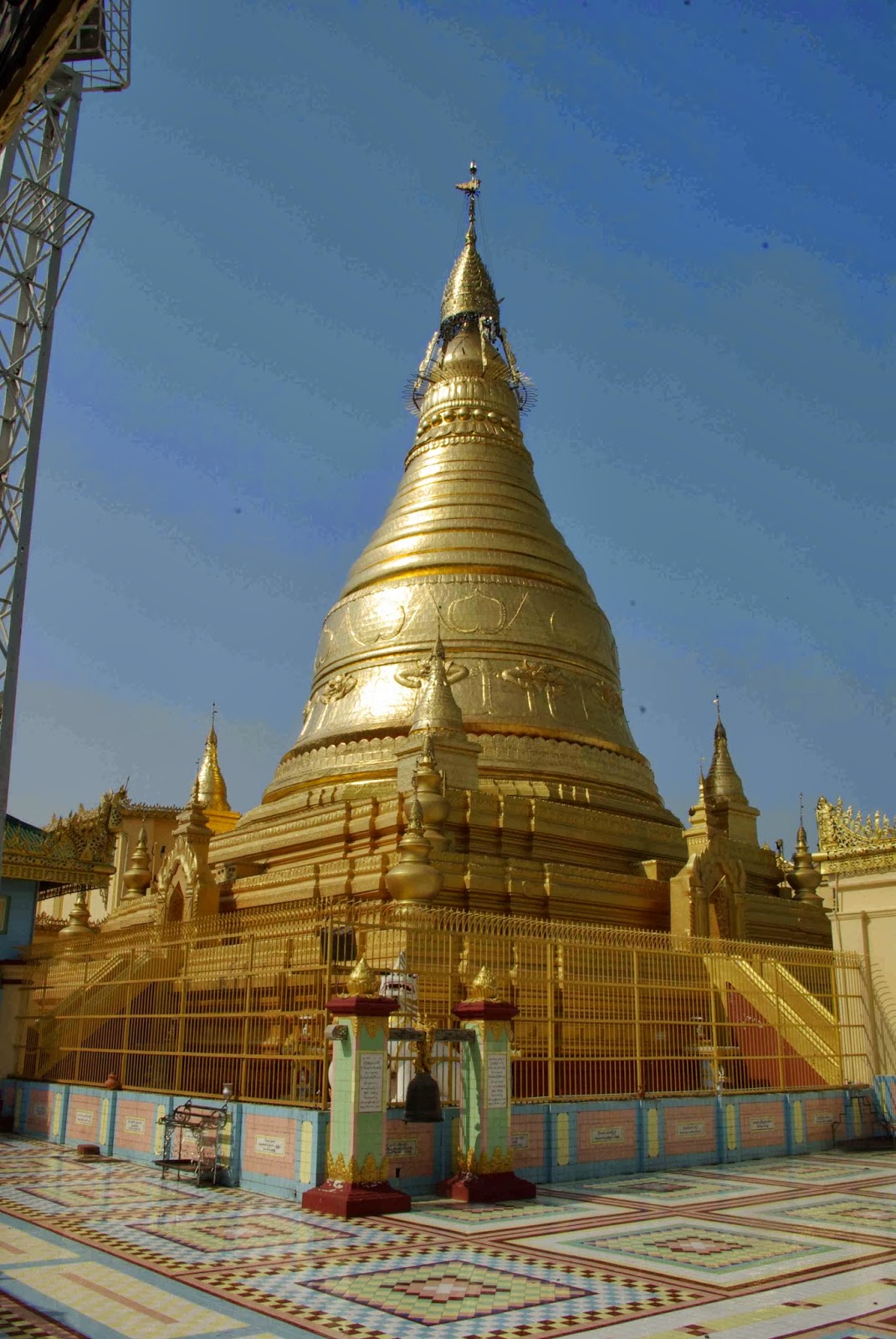
Finally returning to the car, we travelled a little further along the
ridge to the Soon U Ponya Shin paya, the top of Sagain hill. It is the oldest
on the hill, which had dozens of other gold temples dotted among the trees. The
central gold stupa was ringed by shaded corridors, the patterned tiles
mercifully cool for our scorched feet. Below the ceiling line, colourful paintings
told tales from the Buddha’s life, as well as stories about the local kings. Many
alcoves provided lookout spots overlooking the hundreds of hundreds of stupas,
temples and shrines with the mighty Irrawaddy river cutting a track through the
scenery in the distance. Under the various terraces, we enjoyed the view accompanied
by some cooler breezes.
While I was taking photos, a young monk approached, greeting us
confidently in English. Soon we were chatting about our families, homes, jobs
and the weather. He asked us to help him with his English producing an exercise
book. Pages of neat writing attested to his studies. Turning to a new page, he
asked us to repeat our names while he carefully wrote them, along with our home
town, country and date. Handing the book and pen over, he asked me to add a
note in the book. I just wrote a message of encouragement for him to continue
his studies in English, but also the Dharma, signing it with a wish for his happiness.

Our next stop was not on my list to see, Ava, or Inwa. Having read about
it being a tourist trap from other travellers, I thought we could miss it. Driving
towards it in late afternoon sunshine through a picturesque landscape, I
thought we were arriving at U-Bein bridge. Two young girls, one maybe six and
her younger sister about three, met us as we got out of the car, and didn’t
leave our side. Naung Naung gestured for us to buy tickets for the ferry, which
were only 800 kyats each, and to wait. Our two girls then proceeded to dangle
jade necklaces and trinkets in my face, stating we had to buy from her. “No
much people, you must buy. I have no money”. J bought a cold water from another
vendor near by. So the oldest girl set on him to buy me a gift.
Saved by the boat from the persistent girls, we wondered down the
hardened mud bank to the makeship boat jetty. As it was still dry season, the
river level was low, leaving the regular jetty metres above the water. The
short trip over the Myittha canal to Inwa island took only a few minutes. At
the other side, we were met with a few stalls and a group of horse cart
drivers, all vying to take us around. Without too much thought, we just grabbed
the one closest, paying him the fixed fee for the trip to the main sights.
Inwa was an ancient ex-capital of Myanmar covering periods of hundreds
of years, on and off. During its reign, the whole of the north of the country
near Mandalay was known as the kingdom of Ava. Nowadays it’s just another rural
farmland, with bullock carts and rice patties. Much like the carts in Bagan, I
sat on the back while J sat with the driver. Catching glimpses of the old city
walls through the trees along the way, our first stop was the Bagaya teak monastery,
the noted main point of interest. Unfortunately, we were stopped from entering
as we needed the Mandalay tourist zone ticket to enter. J and the driver had a
cigarette while I roamed around and took some shots of the lovely surrounding
fields.


The remains of Yadanar Semi
Pagoda were our next stop, which I enjoyed the most for it’s photogenic ruins
and lone Buddha sitting in the midst of the roofless temple columns. Red brick
stupas and white-washed Buddhas around the small complex were very much like
the temples we’d seen in Bagan. Picking up the speed of the horse cart as we
rode through the pastures, we passed the old Nanmyin watch tower. Though
interesting, our driver informed us it was closed. He stopped at a vantage spot
to allow us to take some photos of the whitewashed tower, which looked a little
rickety and unstable.
 Maha Aung Mye Bonzan monastery
was our last stop. Unusual for the time, it was made of brick and stucco, not
the typical wood like so many others of the era and area. Damaged by
earthquakes, it still stood in good condition. Seeing us arrive, a teenage girl
joined us. She lead us through the small compound, trying her best to speak all
the English words she knew to explain the features of the building. Chatting
with her for a few mintues, we let her finish and explored the exterior terrace
that offered some nice views to the river. Persistent, she simply wouldn’t
leave us be. Sure enough, as we returned to the cart, she asked for 10000
kyats. Way too much. Though not much to us, it was an outrageous request, so
offered her 4000 as that’s what I had readily on hand. She took it with a rude
expression and jumped on her bike to follow us in the cart yelling and asking
for more money. It was an awkward moment. We were happy to be heading back to
the boat to return to Naung Naung.
Alighting from the boat, the girls
were waiting for me. “Ok. Ok. Now you must buy from me. 4000 kyats”, she smiled
dangling a necklace before me with a large jade stone in its centre. As we
walked back up the boat ramp to the car, I bargained with her. Finally, she
made me a deal too good to refuse, 1000 for her and 1000 for her sister.
Bargain. Lucky J had a few loose notes in his pockets. With money in her hand, and
tip, she said her cheeky thankyous before running off.

Sunset wasn’t too far away, so we hurried to U-Bien bridge,
not too far away. A few mini vans and cars were parked along the river shore in
front of a small set of restaurants. With a festival of colourful balloons, in
almost every shape and design, a lone vendor pushed his bike up and down the
car park hoping to make some sales without much success. Lucky for us, there
weren’t too many other tourists. I could only imagine what a circus it would
have been in the peak season. Only a small group gathered in a pavilion closer
to the water’s edge ahead. Not so lucky for our poor balloon salesman.

Stretching as far as the eye could see was the famed teak
bridge. Under its upright posts, a marshy/grassy reserve provided a good place
to set up my tripod to take shots, moving between a few different spots to try
to catch good light. Above, a steady stream of foot traffic made for a
ever-changing scene. To the side, small boats were offering trips out to see
the bridge from other vantage points but J and I were beat. I was content just
taking a few photos. Looking back now, I regret not going out on a boat or even
up to take a bit of a walk along the famous bridge. Oh well, a good excuse to
go back one day.

Many locals were relaxing in the shady cool of evening.
Picking one of the restaurants with the most comfortable looking chairs, J and
I sat down, quickly ordering a couple of cold beers. It seemed we started a
trend, with some other visitors also deciding to come over and have some drinks
and snacks. People watching as the sun set over the laid-back setting was the
perfect way to end our whirl-wind day of sightseeing.
- K
 So, let’s see now, after our failed attempt to see Mandalay
Palace on our first day, we armed ourselves with US dollars to pay the
‘Mandalay Archaeological Zone’ ticket, met Naung Naung out the front of the
hotel, and headed to see the Mandalay sights. We started at the famous palace.
On entry, a number of informational boards were set up containing details about
the thrones and royal regalia. J and browsed the boards before heading inside
the huge complex. Sure it was all new and rebuilt after it was bombed out of
existence during the war, but that did not detract from its sheer scale and
imposingness. Imagine being a visiting dignitary in the 1700s, entering through
the grand gates and being faced with these golden spires and ornate thrones set
in this massive compound. Very impressive. Now empty, the darken rooms only
hinted of the past luxury and opulence that they once held.
 Passing in and out a number of pavilions, we read about how
one was for the Queen, or for the family, or for close advisors, or servants. Without
many details to distinguish between them they sort of blended all together.
Pity there couldn’t be more furniture, decorations and artefacts to display a
more accurate picture of what they would have looked like in their heyday. At
the far end, the last pavilion held some stunning pieces of clothing and royal
ornaments in a mini museum, which I pored over, fascinated. Referencing my not
great memories from the book I had read (Glass Palace), I tried to imagine them
in real, day-to-day use of the royal household.
 Dashing between shadows, we made our way under the eaves of
the numerous buildings to the tower near the entrance. The day was already
boiling hot and the back of my tee-shirt was already wet from perspiration.
Rushing to the shade, we didn’t stop at the lovely looking pool or bathing
house beside the tower. Unlike the rest of the buildings, the white-washed
walls looked old and may have been the original structures. Bright under the
stark sunlight, the white walls and arched pergolas stood out against the other
red buildings.


 It was still late morning. Naung Naung asked if wanted to
see some more, suggesting another teak monastery that he knew but wasn’t as
famous as Shwe Nandaw. We drove to the area around base of Mandalay Hill along
the same road that we took when we went to the summit. We pulled into a small
driveway that from the outside looked like someone’s property. Inside, we found
a well maintained garden and an impressive teak building. Not as ornate as the
others, it was still very impressive with a seven-tiered central spire and
carved detail around the eaves and balconies. Inside was very dark with little
on display apart from a single marble Buddha statue on a small alter. The most
bazaar thing was an old WWII jeep, missing its front fenders, sitting on the
lawn in front of the building.


