Crashing thunder and
pounding rain woke us in the middle of the night. It was spectacular! Every few
seconds, a flash of bright lightening lit up the sky with an accompanying bang
of shot-gun-like thunder. It reminded me of a Hollywood movie – you know the
ones – where the thunderstorm’s light and sounds effects sound totally fake.
This was so intense, with rain as heavy as water a pressure hose used on a car
or windows. J and I got up and stood outside on the little porch of our cabin
and enjoyed watching Mother Nature’s lightshow until it slowly passed over the
mountains out of earshot.

 Morning light crept in
the thin blinds early. After the downpour overnight, I was expecting to see
lakes of puddles everywhere, but it had all soaked into the dry earth (it was,
after all, the end of dry season and the start of the wet). We had plenty of
time to wonder around the hotel grounds after breakfast before Kyaw was due to
pick us up. I ventured out over the road to take some photos of the field and
distant mountains. Passing by in pick-up trucks were groups of young adults,
singing and shouting, with music and some sort of announcement sounding out
over loud speakers. I’m not sure what was going on, but I saw a dozen or so
heading down the road, with the people waving to me as they went by.
Morning light crept in
the thin blinds early. After the downpour overnight, I was expecting to see
lakes of puddles everywhere, but it had all soaked into the dry earth (it was,
after all, the end of dry season and the start of the wet). We had plenty of
time to wonder around the hotel grounds after breakfast before Kyaw was due to
pick us up. I ventured out over the road to take some photos of the field and
distant mountains. Passing by in pick-up trucks were groups of young adults,
singing and shouting, with music and some sort of announcement sounding out
over loud speakers. I’m not sure what was going on, but I saw a dozen or so
heading down the road, with the people waving to me as they went by.
We were ready and
waiting when Kyaw arrived, smiling and chuckling as we greeted. First stop was
Hpa-an town and the morning market. Leaving us to wonder around alone, Kyaw
drove away after confirming a meeting spot in front of a small, red-rendered
mosque. Before us, under colourful beach umbrellas, the market was in full
swing. Turns out, we were there at ‘back to school’ time. Kids were picking
through stationary; mums were measuring up cute green uniforms against
children’s backs; teenagers were thumbing text books and checking each other
out; shoes were tried on; bags filled with supplies; and stallholders were
doing a steady trade.

Further along, the
produce section was a riot of colour and smells – some smells not so great
around the meat and fish section. It’s a little scary to think meat and seafood
sit out in the heat without ice or refrigeration before being bought and
prepared. Makes me feel even more relieved to be vegetarian. A smiling
stall-holder offered me some potatoes when I paused to check out her dangerous
looking chillies and fragrant fresh herbs. Returning her smile, I shock my head
and declined. Other buyers rode their motorbikes almost into the stalls buying
their daily needs. Near our meeting place, we bought some drinks, pausing in
the shade to watch the town’s hustle and bustle. Just over was a well, you
know, a village well where people came to collect water. A skinny man was
working his but off hauling up heavy buckets to disperse to guys on motorbikes
and rickshaws. And we complain about our water bills…

 Down on the waterfront
was Shwe Yinh Myaw pagoda. Circling the walls of the main temple were many
colourful murals depicting stories from the life of Buddha, as well as stories
about local saints and kings. An impressive gold Buddha presided over the main
alter, quite unlike most of the other Buddhas we’d seen to date. Connected to
the temple was a small stupa sitting right on the river bank. A group of
teenage boys giggled as we walked past them, busy playing with their smart
phones. I guess teenagers are pretty much the same world over. Below on the
river, small narrow boats were ferrying passengers and goods to and fro. Rocky
hills and distant mountains rose across the river, with many golden stupas
shining in the morning sun.
Down on the waterfront
was Shwe Yinh Myaw pagoda. Circling the walls of the main temple were many
colourful murals depicting stories from the life of Buddha, as well as stories
about local saints and kings. An impressive gold Buddha presided over the main
alter, quite unlike most of the other Buddhas we’d seen to date. Connected to
the temple was a small stupa sitting right on the river bank. A group of
teenage boys giggled as we walked past them, busy playing with their smart
phones. I guess teenagers are pretty much the same world over. Below on the
river, small narrow boats were ferrying passengers and goods to and fro. Rocky
hills and distant mountains rose across the river, with many golden stupas
shining in the morning sun.

Already, the day was
stinking hot. Well over a hundred on the old scale. Sweat was dripping down my
back as we returned to the car. Our next stop was Kaw Ka Taung cave temple.
Along the road from the cave entrance, a golden robed Buddha with bowl in hand
led a procession of monks on their morning alms collection. The line of life
sized statues extended all the way along the road then around the bend and out
of sight. The cave itself wasn’t overly large, with a line of identical small
white Buddhas sitting around a main alter. Deep inside, down a dark, narrow
rocky passage, we found a little meditation room with an ancient statue behind
a little metal railing. There was only enough space for one seated meditator. I
could just imagine a wandering ascetic staying here, practising calm-abiding,
on the path to enlightenment.
Sadder cave was next,
the one I was looking forward to (as well as dreading) the most. The reason I
was dreading it was due to the bats, and what they leave behind. In Borneo a
few years back, we visited a cave with lots of bats that also had millions of
cockroaches. An experience I never wanted to repeat. However, Kyaw had assured
me that there were no cockroaches and not many bats so I was feeling relieved. At
the entrance, a pair of white elephants guarded the stairway to the cave; climbing
them was a strenuous exertion in the oppressive heat.
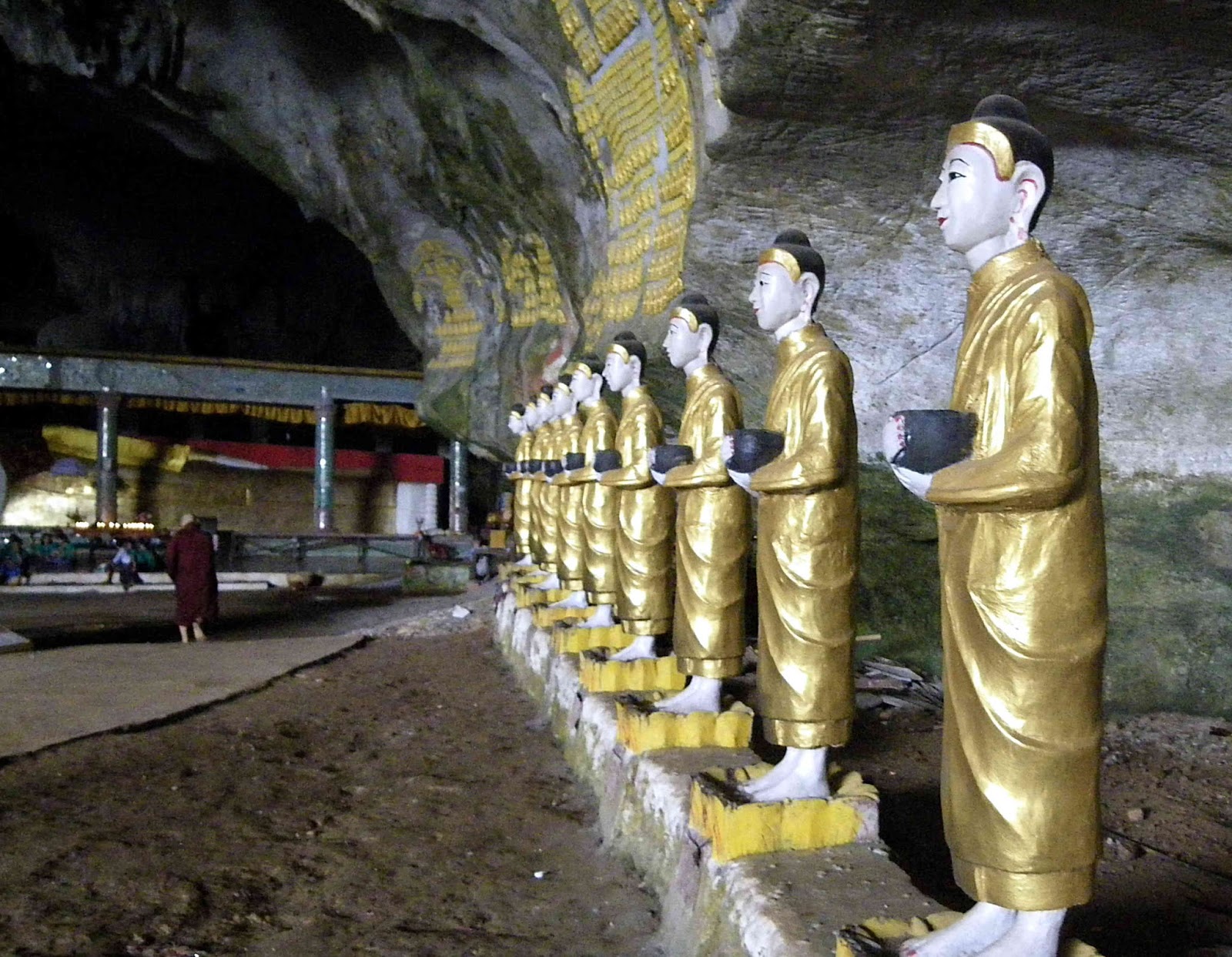 Guiding the path into
the cave, a row of a dozen identical, golden-robed Buddhas, stood holding their
alms bowls. Above them were hundreds of small Buddhas carved into the cave wall
and gilded in gold. Not far away, a large gold reclining Buddha lay beneath a canopy
of many tiny, luminescent tiles that covered the walls, pillars, and sides. A
few locals were praying, making offerings in this amazing place.
Guiding the path into
the cave, a row of a dozen identical, golden-robed Buddhas, stood holding their
alms bowls. Above them were hundreds of small Buddhas carved into the cave wall
and gilded in gold. Not far away, a large gold reclining Buddha lay beneath a canopy
of many tiny, luminescent tiles that covered the walls, pillars, and sides. A
few locals were praying, making offerings in this amazing place.
Prepared with torches, J
and I made our way away from the dim light into the depths of the cave. Many
stalactites and stalagmites hung throughout the cave. No light penetrated too
far into the cave so our torches were quickly switched on. Even in the dark
depths of the cave, there was no escape from the heat, and it felt even warmer inside.
Light posts were in the process of being erected (or repaired) and electricity cables
being strung, as the hand written sign at the entrance proclaimed (verbatim): “All
the tourtst donation some money to repaiks the road ways inside the cave and
milty pose” Looks like future visitors won’t need a torch at all. The path had
many steps and rocky sections. Bats rustled overhead in a few areas, identified
not only by the echolocation sounds
they made, but by also by that distinctive
(and unpleasant) smell of guano. And the squelch of it under foot when you
stepped in it – yuk! Oh did I mention, you have to remove your shoes at the
entrance and complete the journey through the cave bare foot?


 Inside a glass box, a
pure white marble (or maybe it could have been white jade as it didn’t have any
flaws or veins) sat sentinel over the cave entrance. A small flight of stairs
led down to the lake’s bank where we sat under the shade of a tree and enjoyed
the view. Men and boys paddled around in narrow dug out canoes, possibly doing
some fishing, but I’m thinking they were hoping to take visitors around the
lake for a paying fare. The prospect of being out under that burning sun in the
sweltering heat, coupled with the fact we didn’t have any money with us, meant
we didn’t go. It looked so good too. It
appeared hat there was a cave under a rocky hill that the lake or river went
through and under.
Inside a glass box, a
pure white marble (or maybe it could have been white jade as it didn’t have any
flaws or veins) sat sentinel over the cave entrance. A small flight of stairs
led down to the lake’s bank where we sat under the shade of a tree and enjoyed
the view. Men and boys paddled around in narrow dug out canoes, possibly doing
some fishing, but I’m thinking they were hoping to take visitors around the
lake for a paying fare. The prospect of being out under that burning sun in the
sweltering heat, coupled with the fact we didn’t have any money with us, meant
we didn’t go. It looked so good too. It
appeared hat there was a cave under a rocky hill that the lake or river went
through and under.
Back at the car park,
Kyaw had parked beside some stalls selling sweets. Two young monks were
bargaining with the vendor. As we approached, they were quick to say their
“Hellos” and “Where are you from?”, keen to talk to us. I replied and asked
them how old they were, but they didn’t understand so Kyaw had to translate.
Giggling, they also let me take their photos before returning to their important
business of purchasing lollies.
“No more caves now”,
chuckled Kyaw, “we go Mawlamyine see some village on way.” No problem. We were
simply happy to relax in the back, with the air-conditioning blasting after our
hot morning.

Last stop for the day
was a temple off the tourist trail, but I’m sure it will be soon (if it’s not
already). Kawhnat pagoda (in Kawhnat village) is well over a hundred years old
with a number of interesting religious buildings in its compound. An elderly
local man met us at the entrance, who seemed very excited to see us and enthusiastically
ushered us in. He spoke very little English so Kyaw translated for us once
again.
On our right was the
Theingyi ordination hall, written up as, “arguably,
the most impressive ordination
building in the country”. It certainly was remarkable. Crowned with a
six-tiered, spired, golden roof, the building exterior was covered with
multi-coloured, glass mosaic tiles. Intricate, gold painted, wood carvings hung
over the many arched doorways. Silvery pillars held up the second storey roof
between which were many little glass panes boarded with golden frames, like a
stained glass window you’d find in a European church, but all one colour –
green. It shimmered in the afternoon light. Our guide offered to have it opened
up even though women are not permitted to enter. But I declined, wishing to
respect the local custom.

 Eagerly, our keen guide showed
us into the next impressive building, the Dipinkara Wut, or East shrine. Surrounded
by a corridor, the central shrine room contained two giant standing Buddhas,
each carved out of a single piece of teak. Before them sat three monks in
prayer. Along the top of the wall, hundreds of intricately carved teak figures
depicted the lives of the Buddha. Traditional designs were painted in gold over
red walls. The ceiling was amazing, divided into a rectangles decorated with
more glass mosaic. At the centre of each rectangle was a figure, each in a
different posture.
Eagerly, our keen guide showed
us into the next impressive building, the Dipinkara Wut, or East shrine. Surrounded
by a corridor, the central shrine room contained two giant standing Buddhas,
each carved out of a single piece of teak. Before them sat three monks in
prayer. Along the top of the wall, hundreds of intricately carved teak figures
depicted the lives of the Buddha. Traditional designs were painted in gold over
red walls. The ceiling was amazing, divided into a rectangles decorated with
more glass mosaic. At the centre of each rectangle was a figure, each in a
different posture.

We were also shown through the Hna-kyeik-shi-su temple decorated with gorgeous gold painted walls, striking mosaic glass tiles, and elaborate teak carvings. Inside, the stunning nine-tiered pyathat or spired building housed an amazing mural of Buddhist stories, and numerous Buddhas of various sizes and styles, some golden, some white, sitting, laying and standing on a tiered platform.
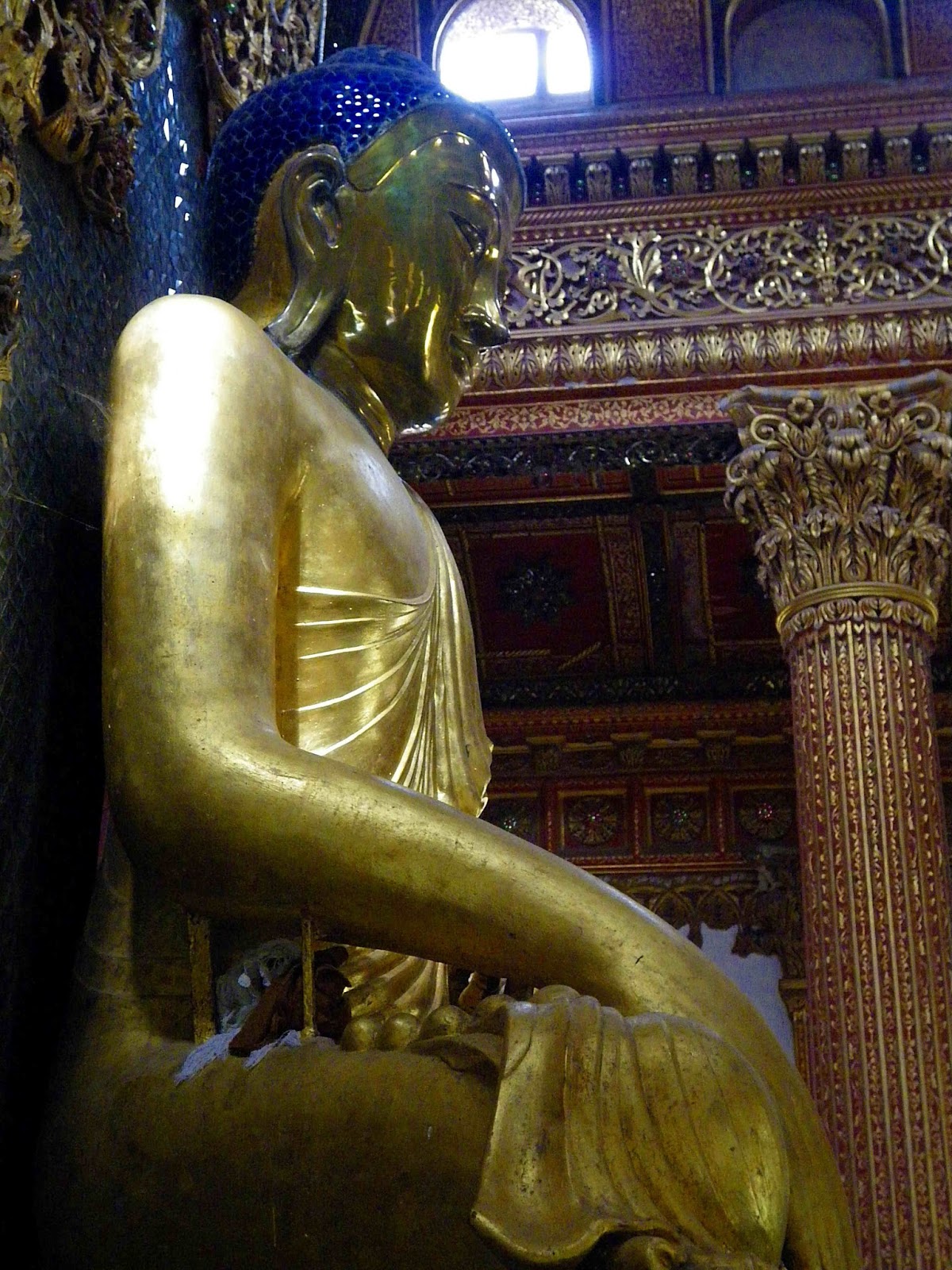
From outside, the Mahamuni shrine looked very plain compared to its brilliant neighbours, with whitish cream rendered walls and plaster embellishments. Over the entrance was a stunning floral design teak carving and more floral carvings decorated the high walls inside. A traditional, large gold Buddha in bhumisparsha or ‘Earth witnessing’ posture sat in the centre of the large dome-roofed hall. More red and gold paintings adorned the ceiling held up by large pillars topped with more painted carvings.
 Our guide explained all
the features of the different buildings, as well as the golden stupa standing
outside in a square surround by all these extraordinary structures. All the
while Kyaw, relayed the information about the various states of repair and the restoration
efforts the Kawhnat Gawpaka committee were undertaking. So much work had
already been complete, and it was truly wonderful, but there was still so much
more to do to repair the many other buildings in the compound. In one of the
corridors, a stand was set up for administration where we were handed a printed
guide of the Kawhnat pagoda compound and a notice asking to help preserve their
treasures. Having been blown away by this amazing place, J and I gave a small
donation, for which we were given an official receipt and much thanks. We were
warmly farewelled and asked to come back soon to see their progress. I sure
would love to return in a year or two to see how magnificent it will be fully
restored.
Our guide explained all
the features of the different buildings, as well as the golden stupa standing
outside in a square surround by all these extraordinary structures. All the
while Kyaw, relayed the information about the various states of repair and the restoration
efforts the Kawhnat Gawpaka committee were undertaking. So much work had
already been complete, and it was truly wonderful, but there was still so much
more to do to repair the many other buildings in the compound. In one of the
corridors, a stand was set up for administration where we were handed a printed
guide of the Kawhnat pagoda compound and a notice asking to help preserve their
treasures. Having been blown away by this amazing place, J and I gave a small
donation, for which we were given an official receipt and much thanks. We were
warmly farewelled and asked to come back soon to see their progress. I sure
would love to return in a year or two to see how magnificent it will be fully
restored.
From Kawhnat, it wasn’t
too far to our stop for the next two nights, Mawlamyine. Cinderella Hotel was
charming and we quickly unpacked, refreshed ourselves, and then headed off to
explore. I also had a special mission to complete. Via TripAdvisor, I’d
connected with a lovely woman from Brisbane who had visited Mawlamyine a few
months earlier. Her and her husband had befriended a local family who had a
food stall along the waterfront, across the road from the police station. She
had taken some photos of the family, and she’d posted them to me at home to
take back and give to the family.
 Though the sun was low
in the sky and night approaching, the outside temperature was still oven-like.
It was only a few blocks to the waterfront, and we meandered along taking in
the river view and quaint buildings along the road. I saw no sign of the food
stalls reportedly set up each night on the footpath. But maybe it was too early.
As we walked down Strand road towards the hotel of the same name, we were
greeted by locals with many “mingalarbars” and smiles. Business for the day was
finishing up and shops were shutting, trucks packed for transport, and people
heading home with fresh food for dinner. Enjoying the afternoon sun (despite
the heat), we made out way along the wide boulevard to the end of the road and
the Attran Hotel. Time for a beer.
Though the sun was low
in the sky and night approaching, the outside temperature was still oven-like.
It was only a few blocks to the waterfront, and we meandered along taking in
the river view and quaint buildings along the road. I saw no sign of the food
stalls reportedly set up each night on the footpath. But maybe it was too early.
As we walked down Strand road towards the hotel of the same name, we were
greeted by locals with many “mingalarbars” and smiles. Business for the day was
finishing up and shops were shutting, trucks packed for transport, and people
heading home with fresh food for dinner. Enjoying the afternoon sun (despite
the heat), we made out way along the wide boulevard to the end of the road and
the Attran Hotel. Time for a beer.
With a cold beer, and side order of French fries, J and I watched the sun set. A group of Americans arrived and quickly had the little restaurant jumping. Requesting cheese and toast, the local women were baffled, and brought them breakfast fare, which they thought was right, only to be told to bring something else. The group become a little impatient and demanding with the wait staff who were doing their best. It was a little embarrassing.
As night fell and the
light quickly faded, we strolled back along the riverfront to see if we could
find the food stalls. When we reached the police station, there was no sign of
them. Let’s try further down. Sure enough, a few hundred metres along, there
were lights and many motorbikes parking and leaving. A dozen or stalls were set
up along the footpath, with a paved area behind them full of tables and chairs
for diners to sit overlooking the water. Drawing closer, I took out the photos
I had to try to identify the stall or faces of the family.


We found a table beside
the fence that edged the river, where there was a little air movement to try to
cool off. We were offered drinks and ordered beer. Watching from our table, we
could see the mother showing the photos to everyone that passed by, beaming
with pride. They looked over at us, and we smiled and waved happy to oblige.
“Eat. Eat”, asked the boy. I replied “Ta ta Lut” (which is something like ‘I do
not eat life’). The boy quickly said, “Oh, you’re vegetarian.” He then lead me
up to show me all the vegetarian food they had. J and I feasted on tasty,
freshly BBQ’ed potatoes, tofu, corn, okra (and chicken and goat for J).
Sitting in the dark
night air (that was still stiflingly hot) with beers and delightful food, I had
the feeling of the world being just that little bit smaller. A connection had
come full circle; us, this family and the travellers back home. This is why I
love travelling.


- K


