Showing posts with label Mawlamyine. Show all posts

Monday, May 13, 2013

Myanmar Part 6 (b) - Mawlamyine & Nwar La Boh Pagoda and back to Yangon

Our last day of our jaunt to the southern areas began much like the last one, breakfast, great coffee with a slightly sore back from the less than comfortable sleep. Packing was made easy after we had a load of washing done the day before (very cheaply may I add), so our clothes were folded to perfection. I took a last look from the bedroom balcony to the shiny pagodas up on the hill behind town before zipping my case and closing the hotel door behind us.

I was a little sad to end this part of our trip, and looking back at my photos, I’m feeling deep regret for not taking more shots of the people and towns, as well as more of the temples and Buddhas. Sure I had taken a few, but honestly, it was so hot most of the time that I had become lazy. Oh well, gives me the perfect excuse to return (not that I need one).

Kyaw picked us up around 8:30 to take us to a place a little off the beaten path, Nwar La Boh, or “hump” pagoda. From the moment I had read about it on Trip Advisor I knew I wanted to see it (in the same way as Golden rock). Half the reason I travel is to experience unique cultural sites and activities, and the less touristy the better. It was to the north of Mawlamyine, sort-of on the way back to Yangon. Kyaw suggested we get there pretty early in the morning with the hope there was a truck going up the mountain to the rocky temple.
A row of tin-roofed shacks sat on a crumbling asphalt road marking the starting point of the journey. Up a little way, a tray truck, set up like the ones we rode in at Mount Kyaiktiyo, sat waiting under an open-sided shed. Compared to the Kinpun truck stop of Golden Rock, it was very basic. In peak times, the stalls and eateries would cater for may pilgrims, serving food and selling supplies. Unfortunately for us, as it was the start of the wet season, so there was no-one else here apart from a couple of families who lived here. We took a seat at one of the stalls while Kyaw talked with the locals. Retuning with his characteristic chuckle, he told us that a truck will go once there were at least eight people. “No problem. Just wait little time”. J and I were not at all worried, and enjoyed just relaxing.
Out of the shade, it was approaching 40 under that blazing sun. Little kids ran in and out, smiling shyly at us while we waited. And waited… and waited. We chatted about various sights around Myanmar as I thumbed my LP guide book, as Kyaw gave me little local insider tips of what to see and when best to go. He also told me what I believe to be a local rumour (whether true or not, I have no idea). The monk who founded this pagoda was the very competitive brother of the monk who founded Golden Rock. He was so jealous of the fame his brother achieved with establishing Golden Rock, he set out to find an even more impressive rock formation to make a into a temple, and so established this site.
An hour later, a car pulled up with four people. Shortly after, another four people walked in from the local town. Yey! That made ten. “OK you pay the driver 8,000 kyats each”, Kyaw explained. “Not so many people so cost more. Sorry for bit expensive”. Near the truck, some of the passengers were trying to haggle with the truck driver. Hard to know the outcome, but we all climbed up onto the truck’s plank bench seats, greeting each other with smiles. Unlike the previous truck trip, we had all the room we needed. Though I’m sure that at peak pilgrimage season, we would have been crammed in like sardines.

Just like our trip up to Golden Rock, the ride itself was reminiscent of a roller coaster. Actually, it was worse. The road was an unsealed dirt track with hundreds of deep potholes. It was steeper and windier. And more scenic with amazing views back to Mawlamyine and surrounding ranges. Holding onto our hats, we laughed and shrieked along with the other passengers as the truck bumped and grinded its way up.

At the top, a golden gateway, framed by a pair of clinthes, marked the entrance. We climbed from the truck onto a covered concrete platform that allowed easy access on and off. A short stroll up a paved walkway with a few sets of stairs lead us to a small monastery building. The locals stopped while an elderly monk recited prayers over them as they bowed their heads. Further up, another monk greeted us under a shaded pergola. Making appropriate hand gestures, he signalled that we needed to pay a camera fee, stuttering “Photo. Five hundred kyats”.

Leaving J to pay, I wondered over to the holy rocks. Nwar La Boh is even more remarkable than Golden rock, with three skinny boulders perched precariously on top of each other. Legend has it that, like Golden rock, Buddha Hair relics have been placed in between the rocks to miraculously hold them in place. Like its more famous cousin, the rocks had been gilded in gold leaf.
A number of tiled terraces provided viewing platforms to see the rock formations from a number of different angles. From some angles, the stack looked larger and more impressive, but at the top, you didn’t quite see just how perilously they rested. Off to the side, a set of stairs lead down to a flattened earthen clearing with a few small stupas, shrines, and a small building, presumably for solitary meditation retreats. Unlike all other stupas we’d seen, one was coated in silver rather than gold, which seems very different to us. 

Our travel companions had made their offerings and prayers at the rocks, and were now exploring this area and wondering off into the bush, leaving J and I alone in this unique site. Two foreigners, alone at a sacred site like this, surely didn’t happen every day – if ever. The rarity of this event was certainly not lost on us.

Walking around the tiled pathway that encircled the rocks, J and I quietly examined and explored the other few shrines and statues, as well as took a heap of photos. Returning to the main alter area before the rock, a stunning blue lizard or iguana was resting on the rock near the top. Another plainer one scurried around the base below. I guess with most of the visitors departed, they had felt safe enough to come out again.

For almost an hour, we wondered around and simply enjoyed the magnificent view. The others hadn’t come back, so J and I headed back to the truck stop, worried that maybe they had returned and the truck left without us. However, there was no sign of them back there either. Only a little stall with a family enjoying a meal. The truck was still parked at the loading platform, and the driver was over the way, also eating his midday meal. OK. They haven’t left without us. But where did the others go? Last I saw them, they were heading into the bushes near the top.

We waited in the shade of the truck stop shelter, sipping water. By now the day was outrageously hot. Gee, I hope they’re OK I thought, wondering how I would ever be able to communicate to the locals that they had gone missing and to organise a search party. But, after a further fifteen minutes, the group appeared from the trees behind the stall. They were laughing and joking around among themselves. It appears they had gone gathering betel leaves (or so J and I concluded).
Climbing onto the truck, they nodded and made fanning gestures indicating how hot they were from their little bush walk. We were sweltering simply sitting in the shade so I could imagine how hot they were. The trip back was quicker, and scarier, than the trip up as the truck travelled much faster down hill than up. Coupled with the ruts and potholes, the uneven track bounced us out of our seats a number of times, causing a few stifled screams followed by giggles of delight. It really was a relief to be back at the base. With a few waves and “Bye-bye’s” to our fellow travellers, we set off back toward Yangon.

Back in the car, I started feeling a little unwell. Sort of funny in the tummy. Having not eaten since breakfast, I put it down to hunger and heat. We stopped at a little town for a late lunch after an hour, where the steamed rice and stir fried veggies hit the spot. The owner brought out beers for us, while his two sons practised their English with us as we ate. “Happy happy” said the owner, seemingly pleased to have had foreigners in his establishment. Small puppies circled at our feet as we enjoyed the cool beer. A few younger children from the neighbouring stalls popped their heads around the corner to see us foreigners, running away giggling when we smiled at them with a little finger wave. All the while, scooters and tractor-jalopy of various sizes came and went from the petrol station and other hardware stands. The town was like a hundred other along the road, the name of which I can’t find or see on any map (and I forgot to ask Kyaw), but the food and hospitality of the host were quite memorable.
It took over four hours to return to the outskirts of Yangon. A new major highway made the last part very quick – that is until we hit the ‘no motor cycle zone’. You see, the local government banned motorbikes in the main city of Yangon. Not far from the airport, there was a very distinctive difference to the traffic once we crossed that point. Suddenly, we were in the midst of a sea of cars; literally bumper to bumper. That last few kilometres to the Myanmar Life hotel close to Yangon airport took almost an hour.
Time to bid a farewell to Kyaw, our jolly driver of the last five days. J and I had put aside a decent tip for him, with us both enjoying his careful and patient driving, as well as taking us to many lesser known places. “When you come back Yangon, you ring me I come drive you”. No problems. We actually arranged for Kyaw to pick us up from the airport in a few weeks when we returned for our last night in Myanmar before flying home.
Check in was smooth, and our room a little non-descript but adequate. I flopped onto the firm bed quite exhausted from our travel. Don’t you find it extraordinary that sitting in a car or plane for hours in transit can be so tiring? That upset tummy feeling had returned, and I knew that this time it was not hunger. O-oh… please no travellers gastro. J went for a wonder up the local street to find some drinks and cigarettes, while I tried to relax. By the time he returned, my digestive system had hit a turning point – literally, making for a less than ideal night’s sleep. Oh well, nothing like a funny tummy for a 6am flight!

- K

Sunday, May 12, 2013

Myanmar Part 6 - Mawlamyine and surrounds

Unfortunately, though the Cinderella Hotel was very comfortable and had great reviews (all worthy), there is one component that didn’t live up to the hype – the bed. Now, we travel a lot and can put up with some pretty tough or hard beds. But not ones that feel like they have wooden planks running along them, or maybe like a mattress base without the mattress top. So we didn’t have the best sleep. Breakfast made up for it with pancakes, eggs for J, toast, fresh fruit and local specialty sweets; one was a fruit-based, agar-agar jelly-ish slice (which J  affectionately calls ‘bllllurbbabbah’ spoken with a bubbly kind of sound affect); the other was semolina cake – both really nice. Oh and great coffee!
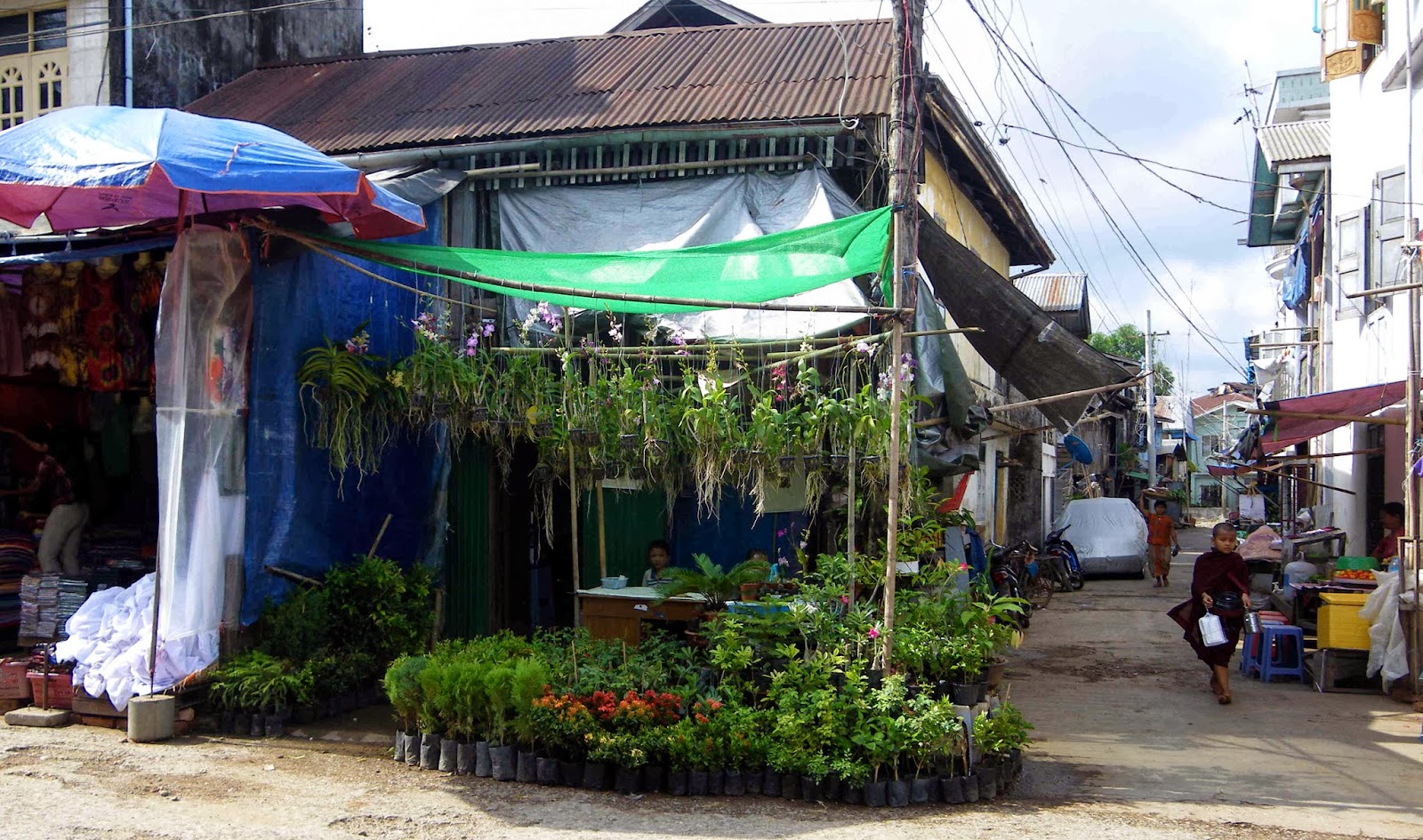
Kyaw picked us up around 8:30am for a new day of sight-seeing. Before we got underway, he suggested a wonder through the local market area. It was spread over a few blocks around Thanton Tadar street not far from the hotel. One street sold mainly fresh fruit and veg, and some meat and poultry, including some poor ducks and chickens being held under large baskets awaiting their fate. But the rest of the ‘market’ was more like a set of close-set shopfronts selling all sorts of goods; clothes, hardware, tyres, pots & pans, the Myanmar version of a shopping mall really. On one corner, we found a little oasis of green. A plant nursery was selling a array of plants potted in large plastic bags, with colourful display of orchids hanging from simple baskets.

Still in Mawlamyine town was our next stop Gaung Se Kyun or ‘Shampoo island’. From what I’d read, the name comes from the Myanmar language term for ‘head medicine’. Hundreds of years ago, royal hair washing ceremonies were performed using a natural spring that flowed on the island. Kyaw organised a long-tail boat to take us over from a small stand on the river bank, almost under the huge Thanlwin bridge, the longest road bridge in Myanamr, that spans the Thanlwin river.

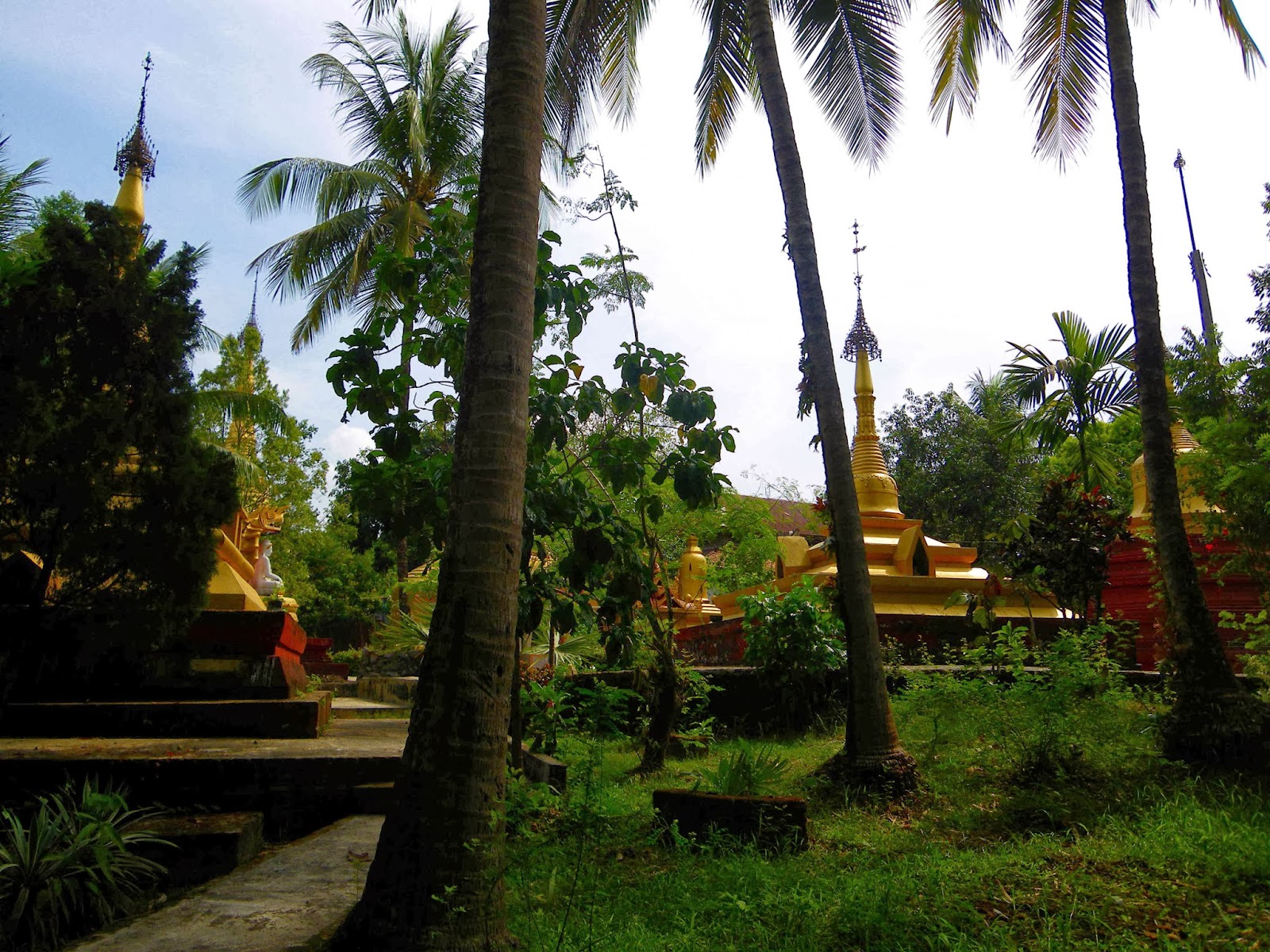
The small island is very peaceful with many tall palms and trees shading many stupas and shrines dotted all around. From the little jetty, we walked in a circular circuit around the island, stopping to look at all the stupas and statues. A rough concrete path provided the route among the trees with many view points over the wide yellow-brown river. Under one small tree, a diorama depicted Buddha’s first teaching to the five ascetics that he had travelled with before his enlightenment. In front of the monastery was the largest zedi (Sandawshin) where we met some locals and nuns out with their dogs. 
There was one very unique and interesting shrine on the island: the Earth, blue sphere with gold-painted continents, sitting upon a five-petal lotus flower, topped with a little stupa and hti.

After exploring for a good half hour or more , we took the little boat back to where the car was waiting. We were happy to be back in his air-conditioned car with a cold drink. The day was already scorching hot and in the high 30s. “Now we see big sleeping Buddha”, chuckled Kyaw, driving off. Passing through some scenic countryside, with some rocky mountain outcrops along the way, we reached Win Sein Taw Ya, the largest reclining Buddha in the world. It rests at the foot of some green hills. A plaque at the entrance proudly proclaims it to be 400 cubits, which is about 560 feet or 180 metres long. He was enormous!

Near the carpark, the entrance was a open building supported by columns with a series of stairs leading to a bridge to access the giant Buddha. Beside it, local kids were splashing around having fun in a large pool full of unwelcoming brown water. J an I made our way to the entry to the Buddha. Inside, we walked through the slightly bazaar interior that was set out over a couple of floors and corridors containing many separate displays, each depicting a story of the Buddha’s life and the six realms of the Buddhist cosmos, as well as scenes from the life of Myanmar’s royalty. Kind of like a museum with plaster figures, brightly painted in fine detail. Many families and groups of teenagers were wondering around. Once again, we were drawn into photos with the locals keen to have their photos with us foreigners. “Mingalabar. Hello”, much smiling and giggles.

Back towards the entrance a monk was leading a prayer session in a small shrine room. Removing my shoes, I took a moment to pay my respects and still my mind after all the activity of the day. J wondered out to see the construction site. Though open with lots of displays completed, the Buddha’s feet were still in progress and I’d say maybe about two-thirds of the interior displays were finished. Outside on one of the terraces near the Buddha’s face, we caught a real feel for the scale of just how huge He was – I couldn’t get his face into a single photo. It also provided a great view of the other stupas and statues that dot the hillside, some of which were also built on a large scale.
As we were leaving, Kyaw stopped at the entrance where statues of hundreds of identical monks lined the road. I hadn’t even seen them on the way in as I was so overwhelmed by the huge Buddha. The day had become more overcast, but even from behind the clouds, that burning sun was still intensely hot. Honestly, watching the countryside go past from a moving, air-conditioned car was just perfect.
It was a good hour or so drive to our next place Thanbyuzayat, the town that lay at the end of the Thai-Burma railway. J and I were keen to pay our respects to the many soldiers that had died constructing the railway under brutal Japanese forced labour during the second world war.
The town was quite a large town, bustling with people selling and buying good from all the many shops. Not far from the main centre, the ‘Death Railway’ memorial sat in a overgrown, roadside clearing that you would drive past if you didn’t know it was there. Down a small path set amongst trees was a large green and black locomotive sitting on a hundred metre section of rail. It was kept in great condition and looked almost new. Beside it, a decrepit monument with almost unreadable inscription stated, “Myanmar Thailand Japanese death railway starts here 1942-1943”. Along the preserved track were some crumbling concrete statues of men depicting the POWs, but they had fallen into complete disrepair and barely recognisable. Still, we felt the area had been kept respectfully to remember those poor souls who suffered so much to build that track.
A bit further up the road was the war cemetery. The grounds keeper met us at the entrance, enquiring where we were from. “Australia”, we replied. “Oh. Many here”, he pointed out to the rows of plaques. Before us were rows and rows of identical (barring the inscriptions) headstones. Each was accompanied by a flowering shrub. The large grass field was mowed to perfection. The grounds and graves are maintained through funds from the commonwealth government and a team of groundskeepers were employed to ensure it was kept immaculately. Near the centre stood a white marble monument shaped like a small wall with a simple and poignant  statement, “Their name liveth for evermore”.
At the entrance, a large plaque read, “Hundreds of thousands Asians, many from Myanmar toiled for 13 months in appalling conditions, building the infamous railway by hand. The railway that stretched from here to Nong Pla Duk Thailand was operational for only 21 months. This plaque records over 80,000 Asians, 6,540 British, 2,830 Dutch, 2,710 Australians and 356 Americans died during the railways construction and it is dedicated to their memory. It commemorates the suffering and fortitude of all who worked on the railway.”
Under the protection of my trusty new umbrella (which was an absolute must under the ridiculous heat), I could only imagine the horrible conditions the POWs suffered. Here I was feeling baked alive just walking amongst the gravestones; hammering iron pegs into the parched ground and laying the track under constant cruelty would have, with no doubt, been hell on earth. J and I read many of the inscriptions on the headstones. Several had the same simple message, “With the setting of the sun, and in the morning we will remember”, others truly touching and personal messages including details of families left behind and love lost. Returning to the entrance, another very Aussie memorial plaque took my eye and had tears welling in my eyes:
“Although many years have passed, since those fatal days of war.
My feelings of pride shall never grow small.
To all those men and women that gave so much,
I only wish we could keep in touch.
War should not be glorified, 
but to all those that fell and fought so well,
did not do so in vain,
 as I for one will always remember them.
Signed, a
 young and mighty bloody proud Australian”.
The plaque also marked a time capsule that had been placed there by surviving Australian ex-prisoners in 1994 entrusting it to the people of Myanmar, with the hope it is opened in 2042 to commemorate 100 years since the beginning of the construction of the Thai-Burma railway.
Back in the car, Kyaw asked whether we had family that fought in the war. Neither J or I did, and it was a bit interesting trying explaining that in fact the country of my family background was on the other side of the allied forces. Despite the fact we had no personal connections, we were still Australian and felt compelled to pay our respects here at this notorious sight. It was one of the reasons why I actually wanted to visit Mawlamyine from Yangon in the first place. A truly moving experience and worth the long drive there and back.

Lunch was at a local street side stall that Kyaw recommended. “Very good food – clean” he smiled leading us to some simple wooden seats. I can’t be sure, but the locals could not believe us westerners at their little local eatery. We were met with wide eyes looks, which were mostly friendly and welcoming. Embarrassingly, the owner came out and tried to find cushions for us to sit on and swept around where we sat. I asked Kyaw to please tell them that we were OK and there was no need. J asked Kyaw to order him whatever he recommended, and of course I asked for ‘ta-ta-lut’ or no life. The food arrived in minutes flat, having come from large pots simmering at the back. It sure smelled great, but mine was not strictly vegetarian with a few shrimp and fish like meat among the veggies and lentils. J shared bowls of pork and fish curries with Kyaw that were heartily enjoyed. But there was one mistake – the cups which we drank fresh water had been washed in not so clean water and I only felt the repercussions a day or so later…
Heading back to Mawlamyine, Kyaw asked if we wanted to see a little place with a very famous temple. Of course I said yes. We took a turn off on our right along a narrow and bumpy country road. It was like many windy roads of country Victoria through rolling hills surrounded by farmland with sweeping corners and many scenic vistas. Descending from the hills, the road flattened, and straightened out, and we were surprised to find ourselves driving along a palm-lined boulevard, not unlike the famous avenue of Beverley Hills just without the million-dollar houses and expensive shops.
The charming town of Kyaik Ma Ya had typical stalls and shops. Through some residential streets of cute wooden houses, we finally came to the local temple that dates back to 1455. A huge gong-like sculpture stood before a green, multi-tiered building. Next to the entry, a stone inscription displayed, “A brief summary of Buddhism”, in English and Pali on one side, and in Myanmar script on the other.
Inside, shady, tiled corridors circled the main shrine room that held a large white Buddha. Distinctive from others, the Buddha was seated as if sitting at a dining table rather than the traditional cross-legged pose. Locals call it ‘western style’, informed Kyaw. 
Surrounding it, a hundred or so golden-robed, white skinned Buddhas sat and reclined. The soaring walls were covered in gold guilt with intricate embossing. A path circled the main Buddha so you could walk all the way around and behind it, so J and I spent a little time looking at all the various mudras and poses of all the Buddhas.
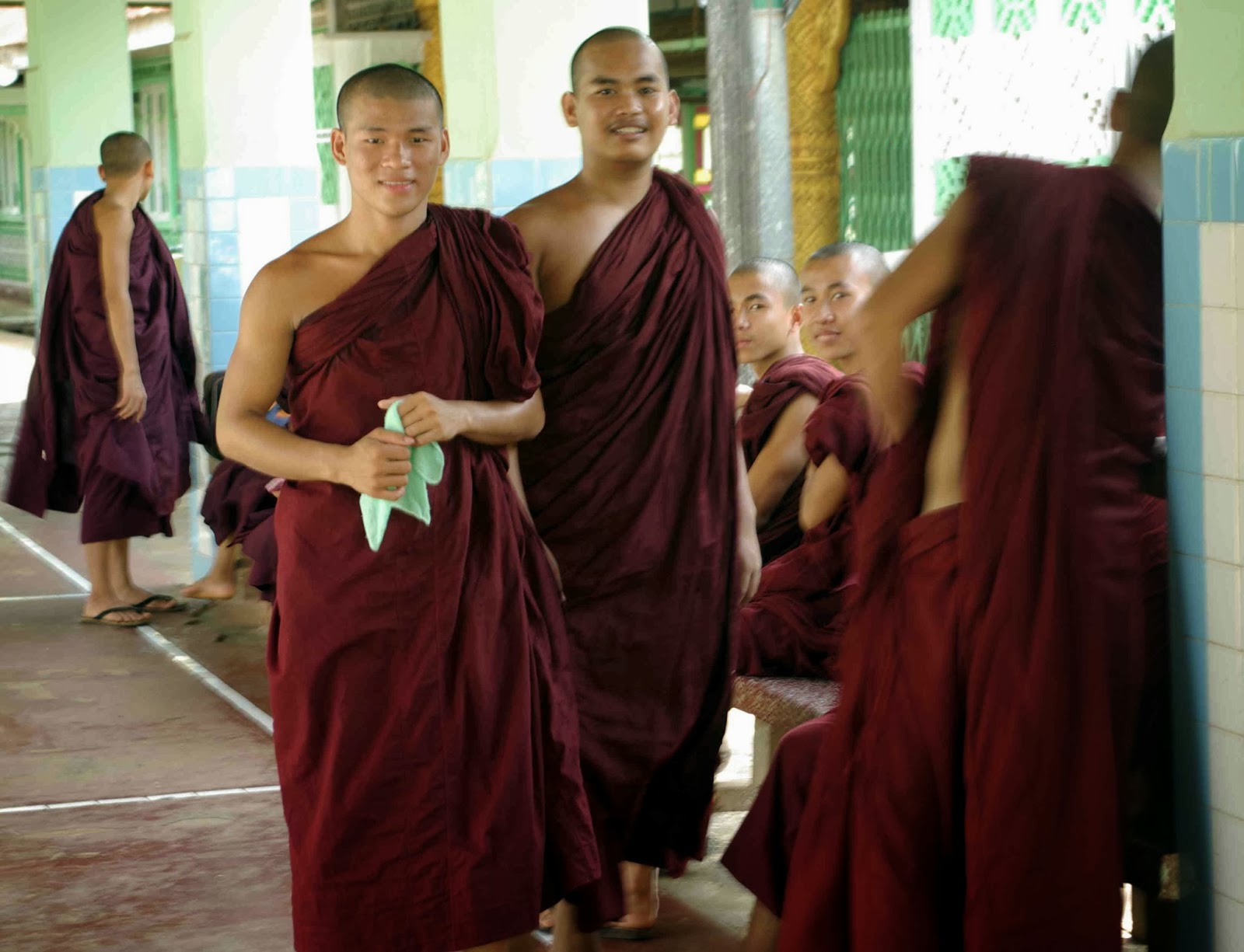
Walking around the grounds, we met a group of monks preparing for afternoon prayers. They were clearly not used to seeing foreigners, laughing and speaking in a highly animated way. 
A bit further around, a young monk with a nasty limp and glass eye approached us shyly. Then, in surprisingly good English, he asked if he could talk with us. From behind him, four younger monks approached. “My students are learning English and have never met people who speak English”. Of course, J and I obliged and we chatted for quite a while about where we were from, what we do for work, families, and then Dharma, which surprised them that foreigners were also interested in Buddhism. The teacher translated for the most, as well as took photos of us with his students on his smart phone. As we walked away, there was much giggling as they examined their images taken with us.
Near the exit, a table was set up with various religious objects for sale. The teacher monk came over and explained that they were raising funds to complete the tiling on the outside corridors and monk’s quarters. Behind the table was a pile of large ceramic tiles, which were the same design as the tiles on the floors around the temple. “People buy to donate for the work”, she explained, “1000 kyats each”. Though we didn’t feel pressured, J and were more than happy to make a small donation. The woman filled out a very official looking receipt book and thanked us profusely as we purchased a half dozen tiles. I wished them well with their fund raising and building works, and we left.
Our last stop(s) of the day were back at Mawlamyine, and the small hills overlooking the town. On the main ridge, a dozen or so monuments, temples and monasteries were spread out along the road. First was U Zina Paya, a huge golden stupa, so named after a famous monk who dreamt of finding gems at the very place it was built. He then proceeded to dig there and sure enough dug them up and sold them, using the proceeds to build this temple. A large, gold adorned clithe stood at the stairs leading to this impressive zedi. From the platform, you could see way out to the mountains to the south and the surrounding countryside.
Nearby, we stopped in from of U Khanti pagoda, another impressive looking temple, with the ‘official’ view point in front that afforded excellent views to the city and river beyond. Locals were relaxing on the circular seats that ringed the large trees. A cool breeze blew providing relief from the afternoon heat. Further along was the Bamboo thread Buddha. It was a unique statue, made from woven bamboo threads (hence the name), painted and draped in gold robes. Housed in a very simple temple, we found it fascinating. A photo board provided background into how it was made, which looked to be quite a very labour intensive and time-consuming task.

Next, Kyaw dropped us in front of a whitewashed building that didn’t look too interesting, but he said to walk in to see the old monastery. It was Yadanar Bon Myint, or Queen Sien Don Mibaya, kyaung that was donated by Queen Sein Don a hundred years ago. It was originally her palace and still houses a large replica Lion throne. Inside, there are may old artifacts as well as some intricately carved ivory tusks, stunning gold and marble Buddhas, and my favourite, beautiful glass floor tiles embossed with gold and painted with colourful flowers. We spent quite a while looking through the various rooms and met an old monk keen to say hello to us. The building is starting to show its age and hopefully will be preserved before it falls into further disrepair.

We walked through a large courtyard, where monks had hung out their washing and skinny cats dozen in the shade, to a covered stairway that lead up to Kyaik Than Lan paya. Its said to be the largest stupa in Mawlamyine. Up on the platform, there was no where to escape the burning sun, but the breeze helped. The view from up there was gorgeous. Around the permitter of the terrace, rows of beach seats lined the square, with many statues of what I think were servants or guardians of the temple standing watch. We explored the various shrines around the stupa, where many locals were praying and making offerings.

As we made our way back down the stairs to where Kyaw had dropped us, a group of young monks came from behind us, their thongs clapping on the stairs. We exchanged hellos and mingalabars as they hurried ahead of us. With the stairway lit up in slanty golden afternoon light, the sight of the maroon clad monks descending made a lovely photo, one of my favourites from our entire trip.

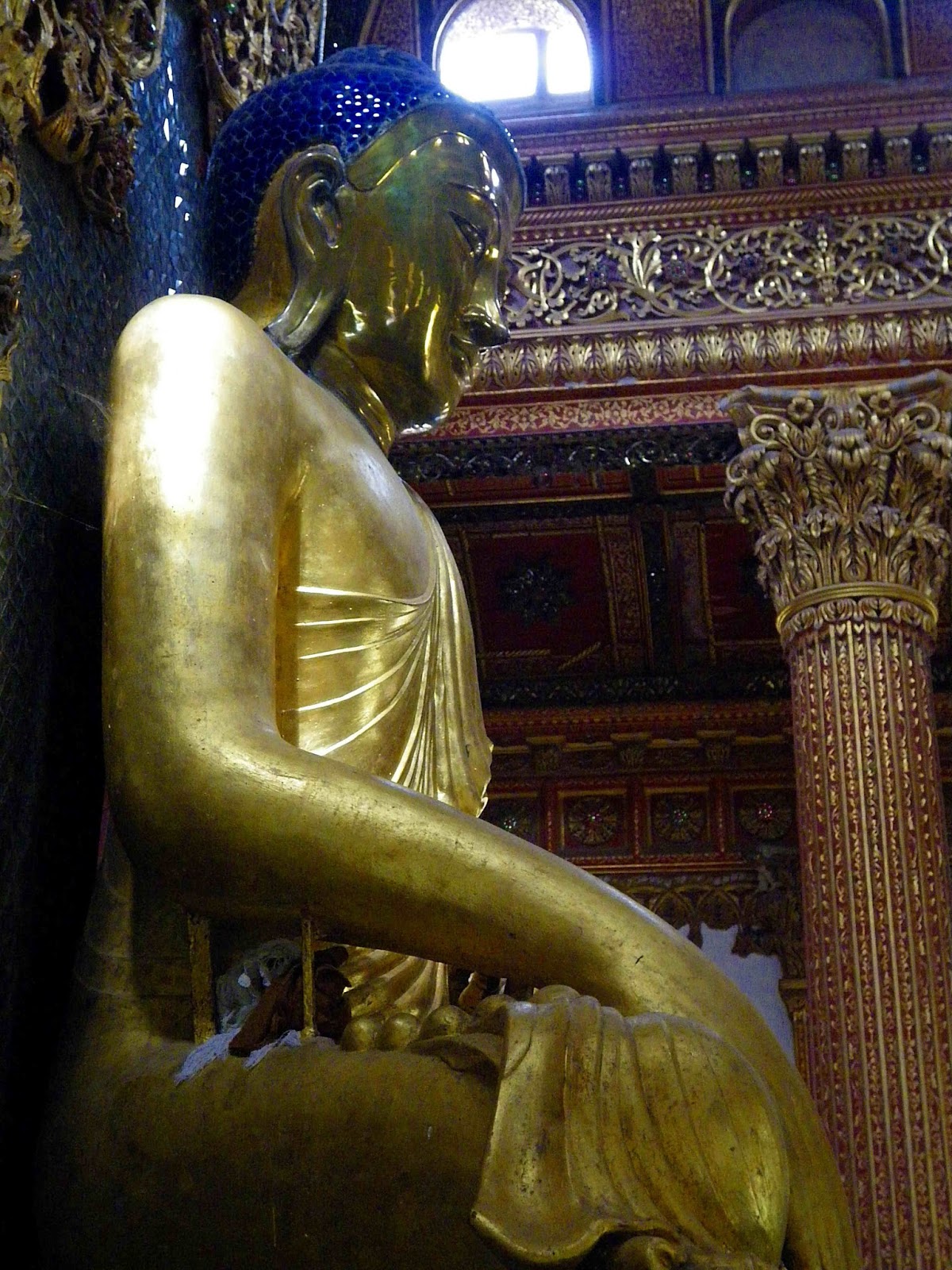
Just up from the monastery, the last stop for the day was the Mahamuni temple. Brilliant in the sunshine, the temple is covered in mirrored tiles. The main shrine’s walls were also a mosaic of colourful glass tiles with the addition of rubies and jade. The Buddha is a replica of the more famous Mahamuni statue that is housed in Mandalay. It is said to be cast in the actual likeness of the historical Buddha, captured by artists during His visit to the north of the country in the year 554 BC. Apart from a solitary woman, praying with a smouldering stick of incense between her palms, we were the only ones there. Another stunning temple.

By this time of the day, we were hot and tired, ready to relax and chill out. The sun was sinking towards the horizon, but we couldn’t be bothered waiting to watch it set from up on the ridge. Driving back to the hotel, Kyaw suggested a local chapatti stand for dinner, which we thought sounded pretty good. He left us to refresh for an hour or so at the hotel before returning to pick us up.

The stand was at the northern part of town, a block over from the Attram hotel. A few simple tables and chairs were placed on the sidewalk. Inside the open stall, a few large pots bubbled away full of aromatic curries. The owner welcomed us warmly, clearly knowing Kyaw. Bringing drinks, he beckoned us to sit down. Kyaw chatted to the owner, before returning to us. Apologising, he explained that the chapattis were not available today. We didn’t mind and asked to be served whatever was recommended (vegetarian for me of course). Bowls of steaming yellow dhal with freshly grilled naan bread were brought, which were delicious. We had a fun chat with Kyaw over our simple but tasty dinner in the evening cool.
To finish our evening, we asked Kyaw to drop us back to the night food stand along the river where we had met that family the night before. It was only early, and J and I were ready for a cold beer with our new friends. Once there, we were welcomed like long lost friends. Beers were brought and the smell of all the scrumptious, barbequed food was so tempting that we couldn’t resist enjoying a second dinner of sorts. We returned to the hotel, deciding to take a route a few blocks over and around to wonder the dark streets of this charming city on our last night. Admittedly, we found ourselves a little off course, at one stage walking up a little residential alley almost into a local family’s lounge room. We all laughed as the one of the eldest children directed us back to the main road. Another delightful experience after a truly wonderful day.
- K

Saturday, May 11, 2013

Myanmar Part 5 - Hpa-an to Mawlamyine

Crashing thunder and pounding rain woke us in the middle of the night. It was spectacular! Every few seconds, a flash of bright lightening lit up the sky with an accompanying bang of shot-gun-like thunder. It reminded me of a Hollywood movie – you know the ones – where the thunderstorm’s light and sounds effects sound totally fake. This was so intense, with rain as heavy as water a pressure hose used on a car or windows. J and I got up and stood outside on the little porch of our cabin and enjoyed watching Mother Nature’s lightshow until it slowly passed over the mountains out of earshot.

Morning light crept in the thin blinds early. After the downpour overnight, I was expecting to see lakes of puddles everywhere, but it had all soaked into the dry earth (it was, after all, the end of dry season and the start of the wet). We had plenty of time to wonder around the hotel grounds after breakfast before Kyaw was due to pick us up. I ventured out over the road to take some photos of the field and distant mountains. Passing by in pick-up trucks were groups of young adults, singing and shouting, with music and some sort of announcement sounding out over loud speakers. I’m not sure what was going on, but I saw a dozen or so heading down the road, with the people waving to me as they went by.

We were ready and waiting when Kyaw arrived, smiling and chuckling as we greeted. First stop was Hpa-an town and the morning market. Leaving us to wonder around alone, Kyaw drove away after confirming a meeting spot in front of a small, red-rendered mosque. Before us, under colourful beach umbrellas, the market was in full swing. Turns out, we were there at ‘back to school’ time. Kids were picking through stationary; mums were measuring up cute green uniforms against children’s backs; teenagers were thumbing text books and checking each other out; shoes were tried on; bags filled with supplies; and stallholders were doing a steady trade.

Further along, the produce section was a riot of colour and smells – some smells not so great around the meat and fish section. It’s a little scary to think meat and seafood sit out in the heat without ice or refrigeration before being bought and prepared. Makes me feel even more relieved to be vegetarian. A smiling stall-holder offered me some potatoes when I paused to check out her dangerous looking chillies and fragrant fresh herbs. Returning her smile, I shock my head and declined. Other buyers rode their motorbikes almost into the stalls buying their daily needs. Near our meeting place, we bought some drinks, pausing in the shade to watch the town’s hustle and bustle. Just over was a well, you know, a village well where people came to collect water. A skinny man was working his but off hauling up heavy buckets to disperse to guys on motorbikes and rickshaws. And we complain about our water bills…

Down on the waterfront was Shwe Yinh Myaw pagoda. Circling the walls of the main temple were many colourful murals depicting stories from the life of Buddha, as well as stories about local saints and kings. An impressive gold Buddha presided over the main alter, quite unlike most of the other Buddhas we’d seen to date. Connected to the temple was a small stupa sitting right on the river bank. A group of teenage boys giggled as we walked past them, busy playing with their smart phones. I guess teenagers are pretty much the same world over. Below on the river, small narrow boats were ferrying passengers and goods to and fro. Rocky hills and distant mountains rose across the river, with many golden stupas shining in the morning sun.

Already, the day was stinking hot. Well over a hundred on the old scale. Sweat was dripping down my back as we returned to the car. Our next stop was Kaw Ka Taung cave temple. Along the road from the cave entrance, a golden robed Buddha with bowl in hand led a procession of monks on their morning alms collection. The line of life sized statues extended all the way along the road then around the bend and out of sight. The cave itself wasn’t overly large, with a line of identical small white Buddhas sitting around a main alter. Deep inside, down a dark, narrow rocky passage, we found a little meditation room with an ancient statue behind a little metal railing. There was only enough space for one seated meditator. I could just imagine a wandering ascetic staying here, practising calm-abiding, on the path to enlightenment.
Sadder cave was next, the one I was looking forward to (as well as dreading) the most. The reason I was dreading it was due to the bats, and what they leave behind. In Borneo a few years back, we visited a cave with lots of bats that also had millions of cockroaches. An experience I never wanted to repeat. However, Kyaw had assured me that there were no cockroaches and not many bats so I was feeling relieved. At the entrance, a pair of white elephants guarded the stairway to the cave; climbing them was a strenuous exertion in the oppressive heat.
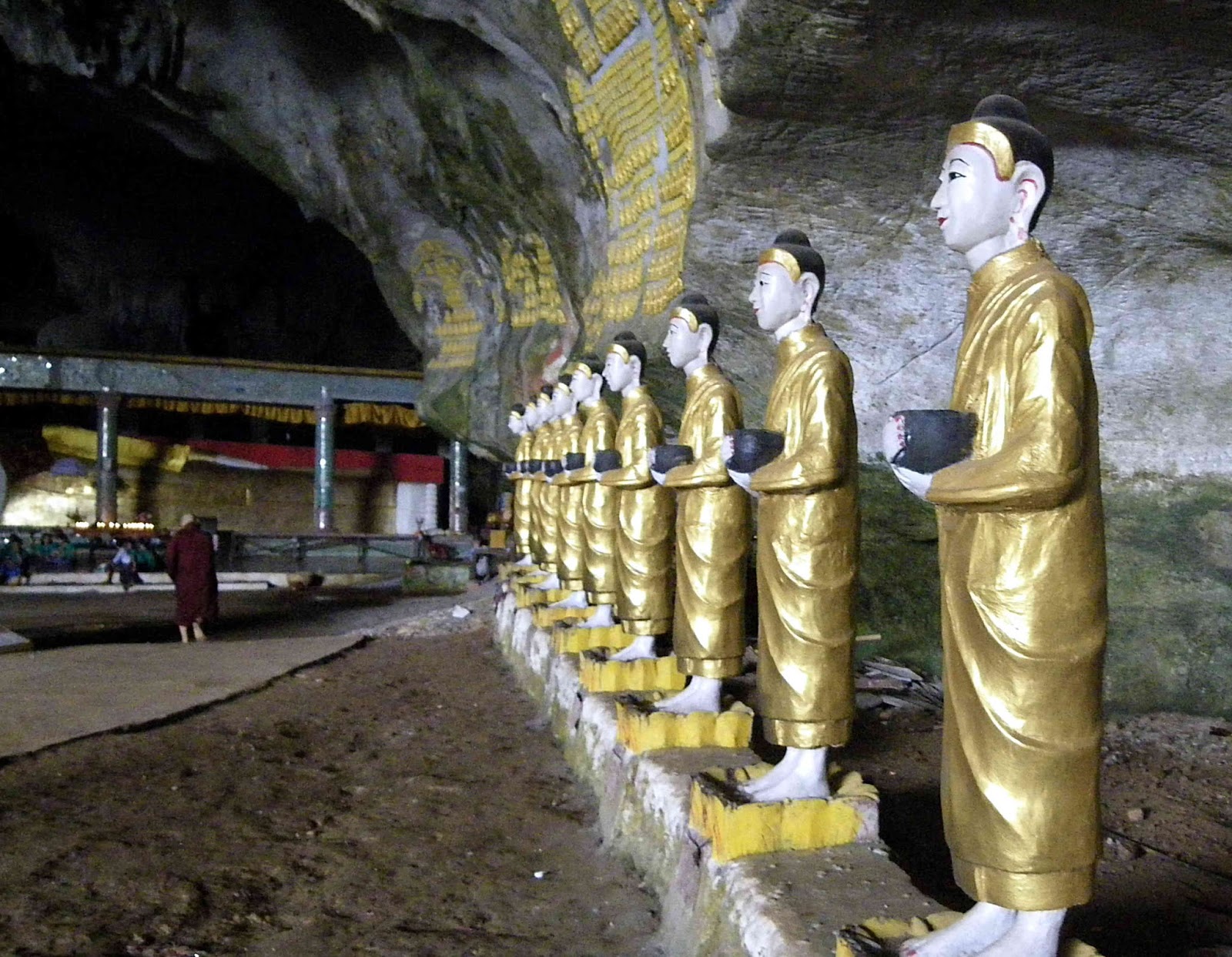
Guiding the path into the cave, a row of a dozen identical, golden-robed Buddhas, stood holding their alms bowls. Above them were hundreds of small Buddhas carved into the cave wall and gilded in gold. Not far away, a large gold reclining Buddha lay beneath a canopy of many tiny, luminescent tiles that covered the walls, pillars, and sides. A few locals were praying, making offerings in this amazing place.
Prepared with torches, J and I made our way away from the dim light into the depths of the cave. Many stalactites and stalagmites hung throughout the cave. No light penetrated too far into the cave so our torches were quickly switched on. Even in the dark depths of the cave, there was no escape from the heat, and it felt even warmer inside. Light posts were in the process of being erected (or repaired) and electricity cables being strung, as the hand written sign at the entrance proclaimed (verbatim): “All the tourtst donation some money to repaiks the road ways inside the cave and milty pose” Looks like future visitors won’t need a torch at all. The path had many steps and rocky sections. Bats rustled overhead in a few areas, identified not only by the echolocation sounds they made, but by also by that distinctive (and unpleasant) smell of guano. And the squelch of it under foot when you stepped in it – yuk! Oh did I mention, you have to remove your shoes at the entrance and complete the journey through the cave bare foot?
Just before we reached the other side, a massive crystallized limestone column stood in the gloom, which sparkled in our spotlight. As we drew closer, the light from the cave exit grew brighter and brighter, with the rocky walls illuminated from the daylight outside. A rocky few steps led to the opening that looked out over a pretty outlook. A little lake reflected the small karst limestone outcrops in it its green waters. It was a bit like walking into a landscape painting.

Inside a glass box, a pure white marble (or maybe it could have been white jade as it didn’t have any flaws or veins) sat sentinel over the cave entrance. A small flight of stairs led down to the lake’s bank where we sat under the shade of a tree and enjoyed the view. Men and boys paddled around in narrow dug out canoes, possibly doing some fishing, but I’m thinking they were hoping to take visitors around the lake for a paying fare. The prospect of being out under that burning sun in the sweltering heat, coupled with the fact we didn’t have any money with us, meant we didn’t go. It looked so good too.  It appeared hat there was a cave under a rocky hill that the lake or river went through and under.
Back at the car park, Kyaw had parked beside some stalls selling sweets. Two young monks were bargaining with the vendor. As we approached, they were quick to say their “Hellos” and “Where are you from?”, keen to talk to us. I replied and asked them how old they were, but they didn’t understand so Kyaw had to translate. Giggling, they also let me take their photos before returning to their important business of purchasing lollies.
“No more caves now”, chuckled Kyaw, “we go Mawlamyine see some village on way.” No problem. We were simply happy to relax in the back, with the air-conditioning blasting after our hot morning.
Last stop for the day was a temple off the tourist trail, but I’m sure it will be soon (if it’s not already). Kawhnat pagoda (in Kawhnat village) is well over a hundred years old with a number of interesting religious buildings in its compound. An elderly local man met us at the entrance, who seemed very excited to see us and enthusiastically ushered us in. He spoke very little English so Kyaw translated for us once again.
On our right was the Theingyi ordination hall, written up as, “arguably, the most impressive ordination building in the country”. It certainly was remarkable. Crowned with a six-tiered, spired, golden roof, the building exterior was covered with multi-coloured, glass mosaic tiles. Intricate, gold painted, wood carvings hung over the many arched doorways. Silvery pillars held up the second storey roof between which were many little glass panes boarded with golden frames, like a stained glass window you’d find in a European church, but all one colour – green. It shimmered in the afternoon light. Our guide offered to have it opened up even though women are not permitted to enter. But I declined, wishing to respect the local custom.

Eagerly, our keen guide showed us into the next impressive building, the Dipinkara Wut, or East shrine. Surrounded by a corridor, the central shrine room contained two giant standing Buddhas, each carved out of a single piece of teak. Before them sat three monks in prayer. Along the top of the wall, hundreds of intricately carved teak figures depicted the lives of the Buddha. Traditional designs were painted in gold over red walls. The ceiling was amazing, divided into a rectangles decorated with more glass mosaic. At the centre of each rectangle was a figure, each in a different posture.


We were also shown through the Hna-kyeik-shi-su temple decorated with gorgeous gold painted walls, striking mosaic glass tiles, and elaborate teak carvings. Inside, the stunning nine-tiered pyathat or spired building housed an amazing mural of Buddhist stories, and numerous Buddhas of various sizes and styles, some golden, some white, sitting, laying and standing on a tiered platform.


From outside, the Mahamuni shrine looked very plain compared to its brilliant neighbours, with whitish cream rendered walls and plaster embellishments. Over the entrance was a stunning floral design teak carving and more floral carvings decorated the high walls inside. A traditional, large gold Buddha in bhumisparsha or ‘Earth witnessing’ posture sat in the centre of the large dome-roofed hall. More red and gold paintings adorned the ceiling held up by large pillars topped with more painted carvings.
Our guide explained all the features of the different buildings, as well as the golden stupa standing outside in a square surround by all these extraordinary structures. All the while Kyaw, relayed the information about the various states of repair and the restoration efforts the Kawhnat Gawpaka committee were undertaking. So much work had already been complete, and it was truly wonderful, but there was still so much more to do to repair the many other buildings in the compound. In one of the corridors, a stand was set up for administration where we were handed a printed guide of the Kawhnat pagoda compound and a notice asking to help preserve their treasures. Having been blown away by this amazing place, J and I gave a small donation, for which we were given an official receipt and much thanks. We were warmly farewelled and asked to come back soon to see their progress. I sure would love to return in a year or two to see how magnificent it will be fully restored.
From Kawhnat, it wasn’t too far to our stop for the next two nights, Mawlamyine. Cinderella Hotel was charming and we quickly unpacked, refreshed ourselves, and then headed off to explore. I also had a special mission to complete. Via TripAdvisor, I’d connected with a lovely woman from Brisbane who had visited Mawlamyine a few months earlier. Her and her husband had befriended a local family who had a food stall along the waterfront, across the road from the police station. She had taken some photos of the family, and she’d posted them to me at home to take back and give to the family.
Though the sun was low in the sky and night approaching, the outside temperature was still oven-like. It was only a few blocks to the waterfront, and we meandered along taking in the river view and quaint buildings along the road. I saw no sign of the food stalls reportedly set up each night on the footpath. But maybe it was too early. As we walked down Strand road towards the hotel of the same name, we were greeted by locals with many “mingalarbars” and smiles. Business for the day was finishing up and shops were shutting, trucks packed for transport, and people heading home with fresh food for dinner. Enjoying the afternoon sun (despite the heat), we made out way along the wide boulevard to the end of the road and the Attran Hotel. Time for a beer.

With a cold beer, and side order of French fries, J and I watched the sun set. A group of Americans arrived and quickly had the little restaurant jumping. Requesting cheese and toast, the local women were baffled, and brought them breakfast fare, which they thought was right, only to be told to bring something else. The group become a little impatient and demanding with the wait staff who were doing their best. It was a little embarrassing.
As night fell and the light quickly faded, we strolled back along the riverfront to see if we could find the food stalls. When we reached the police station, there was no sign of them. Let’s try further down. Sure enough, a few hundred metres along, there were lights and many motorbikes parking and leaving. A dozen or stalls were set up along the footpath, with a paved area behind them full of tables and chairs for diners to sit overlooking the water. Drawing closer, I took out the photos I had to try to identify the stall or faces of the family.
The stalls all looked very similar, with food laid out on trestle tables covered in plastic tablecloths. Hot coals cooked food, open BBQ style, sending wafts of delicious smells on the night breeze. Then I saw a young boy, and a woman with long hair. Hmm. Could this be them? We went to their stall where the boy asked if we would like something to eat in pretty good English. Taking the photos out of my bag, I asked him, “Is this you?” At first, I think he was in shock. His mother came over to see what was going on, and I handed over some of the other photos of her and her children. When she saw the photo of her baby daughter, she made rocking gestures, indicating it was hers. She was overjoyed to see the pictures. Through the translation of her son, I explained that I had brought them to her family from the friends they had made when they were there. They recalled them straight away. The father of the family came to see what we were all looking at, and as soon as he saw the photos, he broke into a laugh. “Sit. Sit”.
We found a table beside the fence that edged the river, where there was a little air movement to try to cool off. We were offered drinks and ordered beer. Watching from our table, we could see the mother showing the photos to everyone that passed by, beaming with pride. They looked over at us, and we smiled and waved happy to oblige. “Eat. Eat”, asked the boy. I replied “Ta ta Lut” (which is something like ‘I do not eat life’). The boy quickly said, “Oh, you’re vegetarian.” He then lead me up to show me all the vegetarian food they had. J and I feasted on tasty, freshly BBQ’ed potatoes, tofu, corn, okra (and chicken and goat for J).
Sitting in the dark night air (that was still stiflingly hot) with beers and delightful food, I had the feeling of the world being just that little bit smaller. A connection had come full circle; us, this family and the travellers back home. This is why I love travelling.


- K